Donor Retention Strategies That Actually Work
connectNPO · Updated September 2026
Key takeaways
- The Fundraising Effectiveness Project reported quarterly donor retention at 18.0% in Q1 2026, roughly flat against 2024’s high of 18.2%.
- Retention fell in the Small, Midsize, Major and Supersize donor segments. Only Micro donors ($1–$100) improved.
- FEP’s own read: retention is steady, and new-donor conversion is the sector’s pain point.
- That makes this a second-gift problem, not a loyalty problem. The work happens in the weeks after the first gift.
- A small team can run a real retention system with a short standing monthly review, if it is written down and owned by one person.
There is a particular kind of quiet that follows a good campaign. The gifts came in. The thank-you emails went out. Someone updated the spreadsheet. And then the year turns, and you look at the list, and most of those names are not on it any more.
It is easy to read that as a verdict on the work. It usually is not. In most small organizations nobody decided to let those donors go. There was simply no moment on anyone’s calendar where keeping them was the job.
This is where most donor retention strategies are aimed at the wrong month. They arrive in year two, when the decision was made in week two. So before the tactics, one reframe, because it changes which problem you are solving — and it turns this into a systems question rather than a sentiment one.
Donor retention is not a retention problem. It is a second-gift problem.
What the data actually says
The Fundraising Effectiveness Project is a joint effort of the AFP Foundation for Philanthropy and GivingTuesday. It draws on more than 25,000 participating nonprofits and more than 125 million donation transactions, and publishes quarterly and yearly reports. It is the closest thing the sector has to a shared scoreboard.
In its Q1 2026 report, dollars grew, decelerating from 5.4% growth the year before. Donor counts fell, but far less steeply than the 2.3% drop a year earlier. Retention held roughly flat, continuing what FEP calls a gentle drift down from 2024’s high of 18.2%.
One detail is worth sitting with. Retention fell within the Small, Midsize, Major and Supersize segments. The only segment where it improved was Micro, donors giving between $1 and $100. The smallest gifts held on best.
Read these numbers carefully. FEP introduced its most significant methodology update in five years alongside this report, describing the changes as refinements rather than reversals. That means this retention figure should not be lined up against older published retention percentages you may have seen quoted elsewhere. Compare it forward, not backward. And note that 18.0% is a quarterly figure. If you calculate your own retention across a full year, as described further down, the two numbers are not comparable and yours will look far higher.
Why the second gift is the real problem
FEP’s own summary of the quarter is the most useful sentence in the report: retention is steady, but new-donor conversion is still the sector’s pain point.
Read that twice. The people who have given to you for years are mostly still there. The leak is at the front, with the person who gave once and never became a giver.
FEP puts it plainly in the same report: the more urgent priority is converting new donors into repeat givers, because aggregate retention gains will not offset a persistently weak first-to-second-gift conversion rate.
Think about how you become a regular somewhere. You do not go back to a restaurant because they emailed you a coupon in November. You go back because the second time you walked in, someone recognised you. The relationship was established on visit two, not by a discount eleven months later.
Most nonprofit retention effort is scheduled for month eleven. The decision was made in week two.
What actually makes someone give again
When you thank a neighbour who helped you move, you do not send a form letter. You say what they did. Specificity is the whole signal, and it is the thing that gets automated away first.
What usually goes out
An automated receipt. A newsletter three months later. An appeal in November. Nothing in between that acknowledges this person specifically.
What earns a second gift
A thank-you that names what their gift did. One update before any ask. A clear, quick way to give again when they are ready.
None of that is expensive. All of it is easy to skip, because nothing breaks when you do.
Donor retention strategies worth starting with
Start narrower than the advice usually suggests. A short sequence you actually run every month beats a perfect programme you abandon in March.
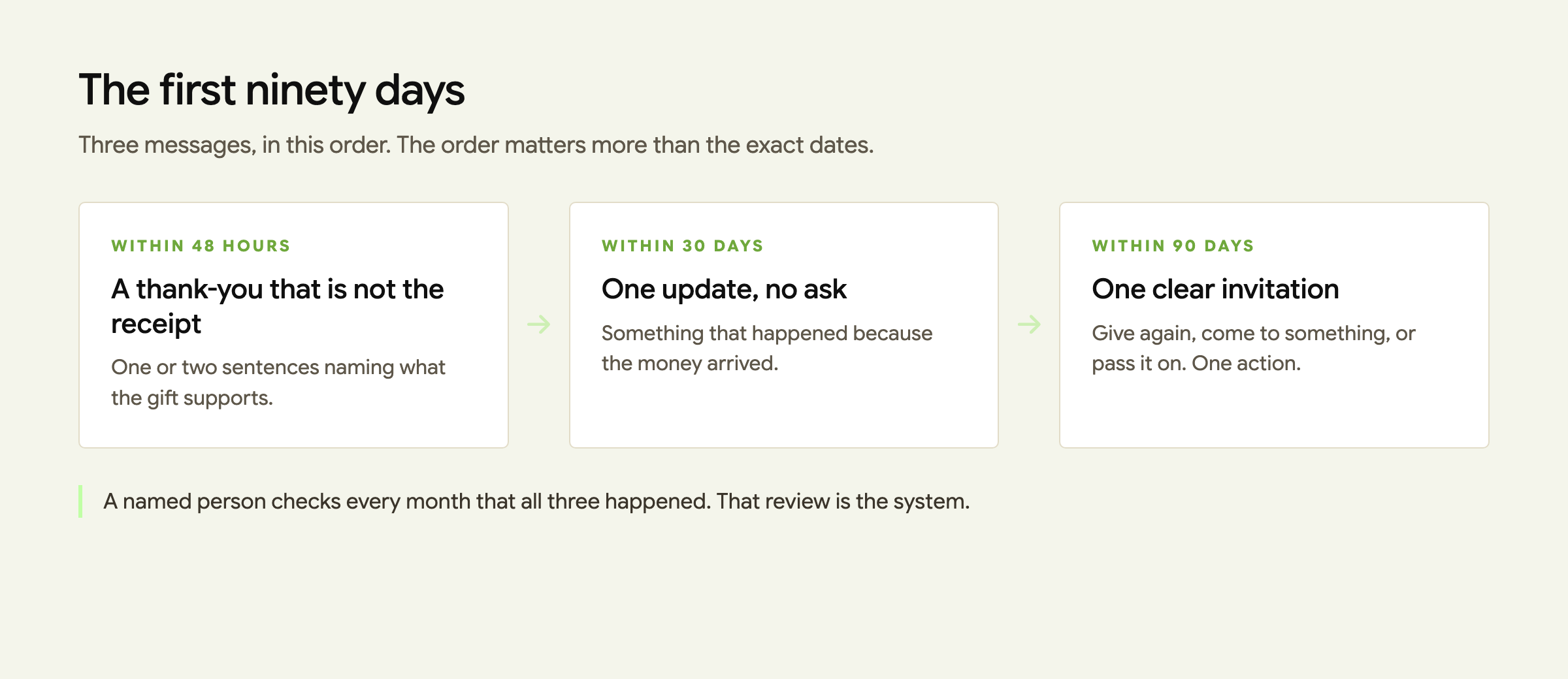
Within 48 hours. A thank-you that is not the receipt. One or two sentences naming what the gift supports. It can be a template with one specific line changed.
Within 30 days. One update with no ask attached. Something that happened because the money arrived. This is the message most organizations never send.
Within 90 days. An invitation to do one more thing. Give again, come to something, forward this to someone. One clear action, not a menu.
Every month. One named person opens the list of first-time donors from last month and checks that all three happened. That review is the system.
A plant does not die because you watered it too little on one occasion. It dies because of the gaps. Retention behaves the same way, and the gaps are what a written sequence removes.
Retention also depends on the machinery around it: whether your donation page works on a phone, whether your list is clean enough to know who is new, whether anyone can tell you this month’s first-time donor count without building a report. Acquisition and retention are two halves of the same system, which is why getting found matters less than it looks if the people who arrive are not kept.
How to know your own number
Sector averages are useful for direction and useless for decisions. An organization with 40 donors and one with 4,000 are not running the same problem, and neither of them is the average. Your own number is the one worth watching, and it takes less work to produce than most teams assume.
The basic version: take the donors who gave last year, count how many of them also gave this year, and divide. That is your retention rate. Run the same calculation for people whose first gift was last year and you have your new-donor retention, which is the number this article is really about.
Three things worth counting every month
New donors this month. If you cannot get this quickly, that is the first thing to fix. Everything else depends on it.
Second gifts this month. How many people who had given exactly once gave again.
Lapsed but recent. People who gave last year, nothing yet this year. This is the list worth a personal note while it is still short.
One caution: a rate you calculate across a full year is not the same measure as FEP’s quarterly figure, and it will come out much higher. Compare your number to your own last year, not to the sector headline.
Reported once a year, retention is a postmortem. Reported monthly, it is something you can still act on. The change is not the metric, it is the frequency.
What to stop doing
Treating the automated receipt as the thank-you.
Saving all contact for the annual appeal, so every message is an ask.
Reporting retention once a year, when nothing can still be done about it.
Adding a new channel before the first ninety days are handled on the ones you have.
The FEP picture is not a story about generosity drying up. Dollars grew. The losses eased. What has not moved is the handoff between a first gift and a second one, and that handoff is a system, not a sentiment.
Where this usually breaks
A returning donor lands on your site before they give again.
We are a nonprofit growth partner. We build the site they land on, and publish the financials a funder checks. More about connectNPO, See how we work, or look at what support costs.
Frequently asked questions
What is a good donor retention rate?
There is no single benchmark that fits every organization. The Fundraising Effectiveness Project reported sector donor retention at 18.0% for the first quarter of 2026. That is a quarterly figure, so it is not comparable to a rate you calculate across a full year. Because FEP also updated its methodology at the same time, it should be compared with FEP’s own future reports rather than with older published percentages.
Why do first-time donors not give again?
Usually because nothing specific happened between the first gift and the next ask. FEP describes new-donor conversion as the sector’s pain point while overall retention holds steady, which points at the weeks right after the first gift rather than at long-term loyalty.
How long should we wait before asking a new donor to give again?
Send something that is not an ask first. A thank-you within about 48 hours and one update within about 30 days, then an invitation around 90 days. The order matters more than the exact dates.
Do we need a CRM to improve donor retention?
Not to start. You need to be able to answer one question reliably: who gave for the first time last month. If a spreadsheet answers that and someone checks it monthly, you can run the sequence. Better tools help once the habit exists.
Which donors are hardest to keep right now?
In FEP’s Q1 2026 data, retention fell in the Small, Midsize, Major and Supersize segments. Micro donors, giving between 1 and 100 dollars, were the only segment where retention improved.
Figures are from the Fundraising Effectiveness Project’s Q1 2026 report and were current when this article was published. connectNPO does not provide legal, tax, accounting, or Form 990 advice.