Nonprofit Annual Report Design: What to Put in It First
connectNPO · Updated September 2026
Key takeaways
- Three different documents get called “the annual report.” Only one of them is the communications piece this article is about.
- The IRS requires exempt organizations to make their annual return available for public inspection. It does not require you to publish a designed annual report at all.
- That makes the annual report voluntary evidence — which is exactly why it carries weight with the people reading it.
- Candid’s free Seals of Transparency already define a public standard for what to disclose, and every level of it is about content, not design.
- A small team can finish a credible report in four short working sessions. Design is the last of them, not the first.
Nonprofit annual report design often gets started in the wrong order. Someone opens a template, picks a cover photo, and then the document sits half-finished for three months while everyone waits on numbers, a board letter, and a decision nobody has made about who the thing is even for. By the time it goes out, the year it describes feels like a long time ago.
That is not a discipline failure. It happens because the report is treated as a design project when it is really a decision project, and the decisions were never made. This article works in the order that actually finishes: what the document is, what belongs in it, and only then what it should look like. Nonprofit annual report design is the last of those steps, not the first.
Three documents share one name
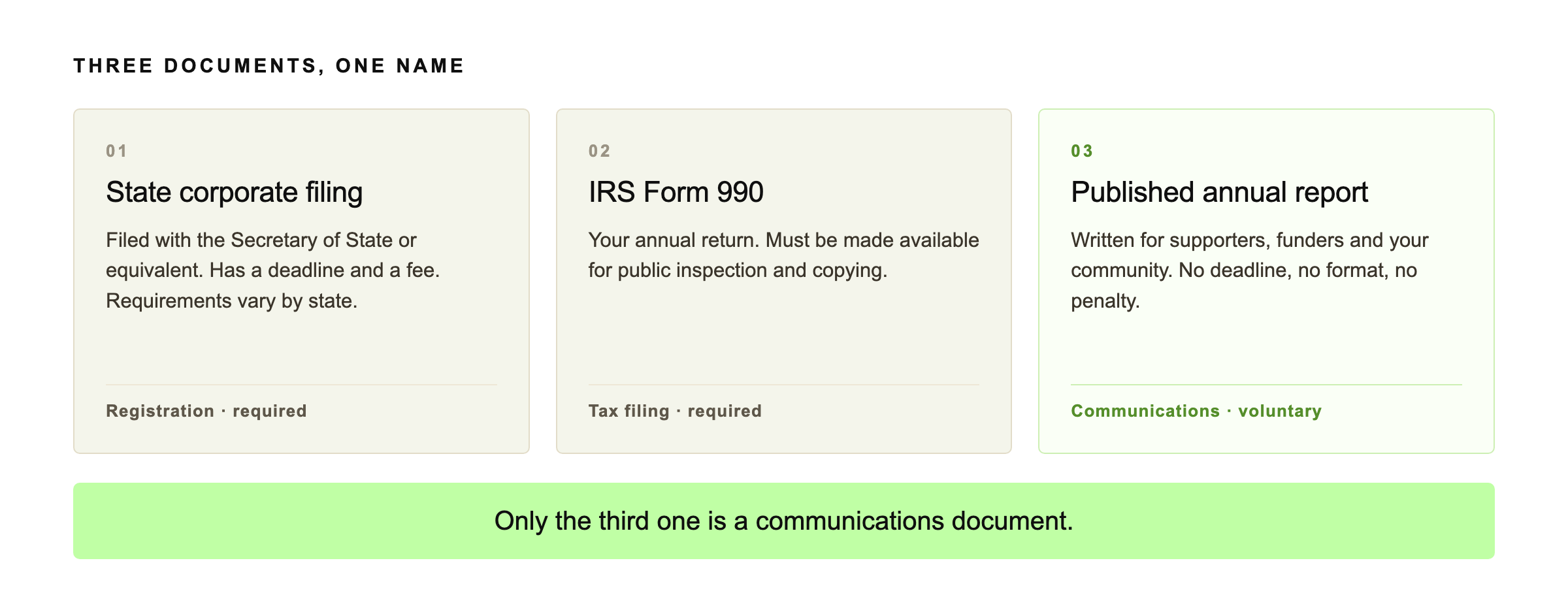
Before anything else, it is worth separating three things that all get called the annual report, because teams routinely think they are talking about the same document when they are not:
- The state corporate filing. Many states require registered nonprofits to file a periodic report with the Secretary of State or an equivalent office, and it is often literally named an annual report. It is a registration matter, usually with a deadline and a fee, though some states ask for it far less often than annually. It is not a communications document, and requirements vary by state.
- The IRS Form 990 series. The annual information return your organization files with the IRS.
- The published annual or impact report. The document you write for supporters, funders and your community. This is the only one this article is about.
connectNPO does not advise on the first two. Your state filing is a legal and registration matter, and your Form 990 belongs with whoever prepares your books. What we can be useful about is the third one, which is a communications and systems problem.
Your Form 990 is already public
This is the part that changes how the whole project should be scoped. The IRS rules on public disclosure state that an exempt organization must make its annual return available for public inspection and copying. Returns must stay available for three years, counted from the return’s due date or the date it was actually filed, whichever is later. Which means the numbers are not yours to release or withhold. Anyone can ask, and they must be provided.
And nothing in those disclosure rules requires you to publish a designed annual report. For most nonprofits there is no deadline for it, no prescribed format, and nothing that happens if you skip it. Some organizations do carry specific federal reporting obligations of their own, hospital facilities among them, so if you are unsure whether something applies to you that is a question for your own advisers rather than for us.
Which is the interesting part. A required disclosure proves only that you were required to disclose. Something you chose to publish, in your own words, when nobody made you, reads differently — the same way a receipt and a note explaining the purchase are not the same object. Voluntary evidence is the kind people weigh.
So what is the annual report actually for
If the numbers are already public, the report is not there to release them. It is there to do the one thing a tax return structurally cannot: say what the numbers were for.
A weather station records the temperature every day, accurately, for years. It cannot tell you that this was the summer the roof leaked. A 990 works the same way. It might show that a program line grew by, say, forty percent. It cannot tell you that the growth was a second site opening in March, that it served a waiting list you had been carrying for two years, or that you closed a different program to pay for it. That connective work is the entire job of the report, and no amount of layout supplies it.
It also helps to be honest about who opens it. In practice it is a short list. Funders checking that you are a real operating organization before a larger conversation. Board members who need something to hand people. Donors who already gave once and are deciding whether to give again. None of those readers is browsing for inspiration. Each is looking for evidence.
What to put in it, using a standard that already exists
You do not have to invent the contents list. Candid, which runs the nonprofit profiles many funders check, publishes a free, opt-in set of Seals of Transparency in four levels. What each level asks you to disclose, earned in order, makes a usable outline for a report:
Bronze
Be findable
Who you are, where you work, how to reach you, and how to give to you. In a report this is the first page, not an afterthought.
Silver
Explain the work
Each program named and described, with the area it serves. One short paragraph per program is enough.
Gold
Show financials and leadership
Candid’s own line for it: “Share your financials and leadership demographics to gain funders’ trust and support.”
Platinum
State goals and metrics
Goals, strategies, board demographics, and at least one quantitative metric from 2025 for the 2026 seal. This is the section easiest to leave out, and the one funders are looking for.
Notice that nothing in that progression is a design instruction. Every level is about what you are willing to say. Candid also expires a seal if the information is not updated yearly, which is its own argument for treating this as an annual habit rather than a one-off. The same four questions make a serviceable table of contents whether or not you ever claim a profile.
On the financial section specifically: your job in the report is to present figures your bookkeeper or accountant has already produced, in plainer language than the return uses. It is a communication task, not an accounting one. If the underlying numbers are not settled yet, the report is not the place to settle them.
A version a small team can actually finish
You decide what you are taking before you choose the bag to put it in. Design is the bag. The reason these stall is that they are treated as one large project instead of four small decisions, with the bag chosen first. Four working sessions, roughly ninety minutes each, will get a small team to something publishable.
01Session one
Decide the audience and the length
Pick the one reader who matters most this year, and set a page count before you write anything. Four honest pages beat twenty unfinished ones, and the page count is what stops the scope from drifting.
02Session two
Write the three sentences you can prove
What changed, for whom, and how you know. Everything else in the report exists to support those three sentences. If you cannot prove one, cut it rather than soften it.
03Session three
Assemble the evidence
Programs and areas served, the financial summary from your books, leadership and board, and at least one quantitative metric with its year attached. Dated photographs if you have them, and no stock imagery of people who are not yours.
04Session four
Lay it out and publish it somewhere permanent
A page on your own site that keeps its URL, with a PDF available. A report that lives only in an email attachment cannot be found later, and being found later is most of its value.
If this is your first one, or your team is very small, treat that as a starting shape rather than a standard. Do session two and session three properly and publish a plain four-page document; add the rest in later years. A short report you actually publish every year beats an ambitious one that appears twice and then stops.
Where nonprofit annual report design actually helps
None of this is an argument against nonprofit annual report design, or against making the thing look good. Design does real work in a report — it just does not do the work people hope it will. It cannot make thin evidence convincing, and a beautiful report with nothing provable in it reads worse than a plain one, because the effort is visible and the substance is not.
What design genuinely earns its place doing:
Making the numbers readable. One clear chart instead of a table nobody parses.
Letting people skim. Headings and pull quotes so a funder finds the section they came for.
Working on a phone. Most people will open it on one, and a print-shaped PDF is unreadable there.
Looking like you. The same type and colors as your site, so it is recognizably the same organization.
That last one is worth a note. Consistency across a report and a website is usually not a taste problem but an ownership one, which is the same pattern we wrote about in nonprofit branding. And because the people who open the report have usually given you something already, it is quietly part of donor retention rather than a separate exercise.
If it stalls every year
The problem is usually the process, not the template.
Nobody is grading the cover. The report earns its keep when a funder can open it and see, quickly and without generosity of interpretation, that you did what you said you would do. We are a nonprofit growth partner and this is the kind of thing we help teams put on a repeatable footing. More about connectNPO, see how we work, or look at what support costs.
Frequently asked questions
Is a nonprofit required to publish an annual report?
Not as a published communications piece. IRS rules require an exempt organization to make its annual return available for public inspection and copying, but they do not require you to produce a designed annual or impact report. Separately, many states require a periodic corporate filing that is also called an annual report, which is a registration matter and varies by state. connectNPO does not provide legal, tax or accounting advice on either of those.
What should a nonprofit annual report include?
A usable outline is the one Candid publishes for its Seals of Transparency. Start with who you are, how to reach you, and how to give to you. Add each program with its description and the area it serves. Then financials, plus leadership and board demographics. Then your goals, strategies, and at least one quantitative metric from the year Candid specifies for the current seal. On top of that, write three sentences you can prove: what changed, for whom, and how you know.
How long should a nonprofit annual report be?
Set the page count before you start writing rather than after. Four honest pages that get published every year are worth more than twenty that appear once. Length is the main thing that decides whether a small team finishes, so treat it as a decision rather than an outcome.
Do we need a designer for our annual report?
Not for the first one. Design helps most with making numbers readable, letting people skim, working on a phone, and matching the rest of your identity. None of that is worth paying for until the contents are decided, because a designer can only lay out material you have already gathered.
Where should we publish the annual report?
On a page of your own site that keeps the same URL, with a PDF available to download. Reports that exist only as an email attachment or a file in shared storage cannot be found by someone checking you out a year later, and being findable later is most of what the document is for.
IRS public disclosure rules referenced were last reviewed or updated by the IRS on June 28, 2026, and the Candid Seals of Transparency described are the 2026 seals. Both were current when this article was published. connectNPO does not provide legal, tax, accounting, or Form 990 advice.