Nonprofit Email Marketing: Send Less, Lose Fewer
connectNPO · Updated September 2026
Key takeaways
- The M+R Benchmarks 2026 study reports sector email revenue up 16% in 2025, while lists grew only 5% and revenue per subscriber jumped from $1.87 to $2.40.
- Most of that growth came from the people already on the list, not from new ones. Revenue per 1,000 fundraising emails also rose 4%.
- Small organizations grew fastest at 21.7%, ahead of the largest at 9.8%. This is not a strategy that only works at scale.
- The constraint is the list itself. M+R puts total annual churn at 18.8%, and the unsubscribe rate rose 25% in a year.
- Google has required SPF or DKIM authentication and a spam rate under 0.3% from every sender since February 2024. Nothing else works until mail arrives.
Nonprofit email marketing advice tends to arrive as a list of things to write better. Subject lines. Story openings. A clearer ask. All of it is fine advice, and none of it explains why the newsletter your team spent a week on landed with almost no response.
The published benchmarks explain more of it, but only if you read past the headline. Last year the sector grew email revenue substantially, and organizations your size grew it fastest of all. The mechanics underneath that growth are worth understanding, because they tell you which lever is actually yours to pull.
What the 2026 benchmarks actually say
The reference point for this channel is the M+R Benchmarks study, whose 2026 edition covers 2025 activity. Every figure below is a median, and each metric is calculated separately, so the numbers do not reconcile into one tidy picture. They are still the clearest read available on the channel.
A few more, because they matter later. Email accounted for 11% of online revenue. The average subscriber received 50 messages over the year, 31 of them fundraising appeals. Revenue per subscriber rose to $2.40, up from $1.87. And the study reports no open rate at all, which is its own quiet verdict on how much that metric is still worth.
Where the 2025 growth actually came from
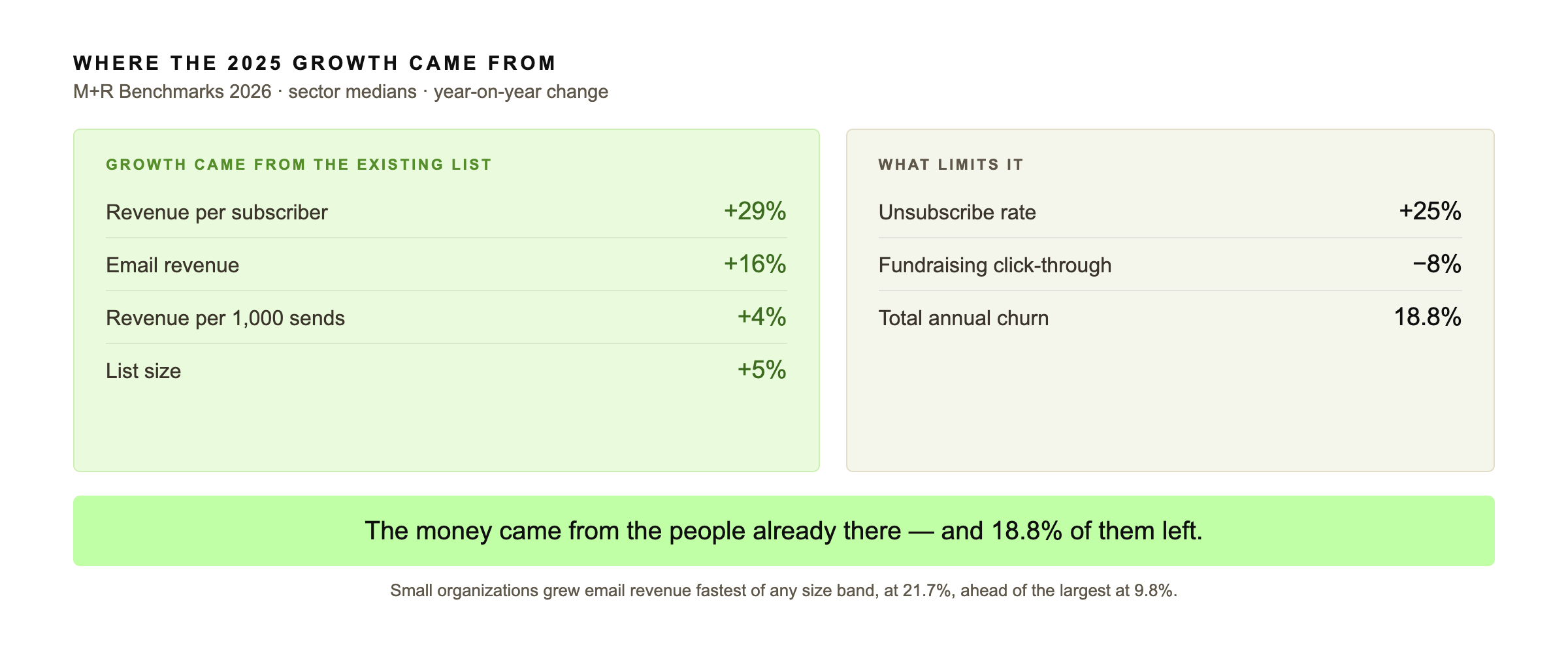
Put the numbers side by side and a clearer story appears. Email revenue rose 16% and volume rose 15%, which looks at first like growth bought with sheer output. But lists grew only 5%, while revenue per subscriber went from $1.87 to $2.40 — an increase of roughly 29%.
That last figure is the one worth sitting with. Revenue grew far faster than the audience did, which means most of the growth came from the people already on the list rather than from new people. Revenue per 1,000 fundraising emails rose 4% as well. The sector did not only send more; it got more from the same room.
Two things moved the other way at the same time. Click-through on fundraising email fell 8%, and the unsubscribe rate rose 25%. So the growth was real, and it was drawn from an existing audience that was engaging a little less per message and leaving a little faster.
Here is the part that should encourage you, and it is the opposite of what most benchmark coverage implies. Small organizations grew email revenue 21.7% last year — more than any other size band, and well ahead of the largest organizations at 9.8%. This is not a strategy that only works at scale. It is genuinely available at your size.
What is not unlimited is the list you run it on. You can draw more water from the same well, and for a while the bucket comes up just as full. The well is still the thing that decides how long that lasts.
Make sure it arrives before you make it better
Nonprofit email marketing fails at the inbox before it fails at the subject line. A letter that never makes it through the door was never badly written; it was never read. There is no point rewriting a subject line for a message that did not arrive. Since February 2024, Google has published requirements for anyone sending email to Gmail addresses, and they are enforced rather than advisory. A meaningful share of your list is on Gmail.
These apply to every sender, regardless of size:
- SPF or DKIM authentication on your sending domain. This is a DNS change, usually made once.
- Valid forward and reverse DNS records for the sending domain or IP.
- A TLS connection for transmitting mail.
- A spam rate under 0.3% as reported in Google Postmaster Tools.
Google’s additional bulk-sender rules, which add DMARC, sender-domain alignment and one-click unsubscribe, apply at 5,000 messages a day to Gmail. Most organizations at this size will not reach that, so those are worth setting up eventually rather than urgently. The four above are not optional for anyone.
The spam threshold is the one to watch, because it connects to everything else in this article. It is a rate, not a count, so a small list has less room to absorb a bad send than a large one. Postmaster Tools is free, and if nobody at your organization has ever opened it, that is the single highest-value hour available to you this quarter.
Churn is the number that decides a small list
Here is the figure that gets least attention and matters most. M+R publishes total annual list churn separately from its bounce and unsubscribe figures, and for 2025 it puts churn at 18.8%. Close to a fifth of the list becomes unreachable over twelve months, before you have grown anything. Resist the temptation to reach that number by adding the 4% bounce rate to the 12% unsubscribe rate, as the study calculates each median separately and publishes the combined figure precisely so you do not have to.
The arithmetic on a list of 4,000
At sector churn of 18.8%, you lose roughly 750 subscribers over a year. To finish flat, you need 750 new sign-ups. To grow 10%, you need about 1,150. Which means list growth has to come from somewhere, and Google Ad Grants is one of the few free channels that can feed it.
Now the other side. At the benchmark fundraising response rate of 0.050%, a full-list appeal to those 4,000 people produces about two gifts. Sending more appeals to a shrinking list is not a growth plan.
This is a greenhouse with a cracked pane. You can keep planting, and things will keep coming up, and the heat will keep escaping through the same gap all winter. The planting is not the problem. Nobody enjoys fixing the pane, because it produces nothing visible on the day you do it.
Reducing churn is unglamorous work: sending less to people who never open, sending something that is not an ask, removing addresses that have bounced instead of retrying them, and giving people a reason to have joined in the first place. It is the same pattern as the second gift in donor retention — the win comes from what happens between the asks.
A cadence a small team can hold
The benchmark subscriber received 50 messages a year, 31 of them appeals. That is a two-thirds ask ratio, and it is a large organization’s cadence run by a team whose job it is.
A useful cadence for a small team is one you can hold in a bad month, because bad months are when it breaks. That usually means monthly, not weekly, with the ratio inverted:
- One update a month that is not an ask. Something you did, with a date on it. This is the same material you would put in an annual report, published in monthly installments instead of saved up.
- Two or three appeals a year, tied to real moments rather than to the calendar’s expectations.
- A welcome message that goes out automatically when someone joins. The benchmark welcome-series click-through rate is 1.6%, more than two and a half times the fundraising rate. Two caveats the headline number hides: that rate fell 15% year on year, and welcome messages carry a 1.16% unsubscribe rate, roughly five times the overall average. People decide quickly whether they meant to sign up, which is an argument for saying plainly what they will get.
If that feels thin next to 50 messages a year, compare the right things. Nonprofit email marketing is not measured in sends. Fifty sends that erode your list is not more email than twelve that hold it. It is more sending.
Where to start with nonprofit email marketing
In this order, because each step makes the next one worth doing. If your organization is small or new, do the first two and leave the rest for later — a short routine you actually keep beats a full program you abandon in March.
- Check authentication. Confirm SPF or DKIM is set on your sending domain, and open Google Postmaster Tools to see your spam rate. This is a one-time fix with permanent effects.
- Clean the list once. Remove hard bounces. Suppress addresses that have not opened or clicked in a year. Your numbers will look worse and your delivery will get better.
- Turn on a welcome message. One email, sent automatically, saying what they signed up for and roughly how often they will hear from you.
- Write down the cadence and give it one owner. An unwritten cadence is a wish.
- Track two numbers a month: net list change, and unsubscribes per send. Everything else can wait until those two are stable.
If email feels like shouting into a void
It is usually deliverability and cadence, not writing.
The benchmarks are worth reading every year, as long as you read them as a description of a sector rather than a set of instructions for your organization. Nonprofit email marketing at your size is a smaller, steadier machine than the averages suggest. We are a nonprofit growth partner and this is the layer we work on. More about connectNPO, see how we work, or look at what support costs.
Frequently asked questions
How often should a nonprofit send email?
Often enough that people remember you, rarely enough that you can keep it up in a difficult month. For a small team that usually means one update a month plus two or three appeals a year. The sector median is 50 messages a year per subscriber, but that reflects organizations with dedicated staff and several channels feeding the list. Frequency is not what separated the fastest-growing organizations last year.
What is a good open rate for nonprofit email?
Open rate is no longer a reliable measure, because privacy features in some mail apps register opens that did not happen. The M+R Benchmarks study reports no open rate at all. Use click-through rate, response rate, unsubscribes per send and net list change instead.
Why does our nonprofit email go to spam?
Most often because the sending domain is not authenticated. Google has required SPF or DKIM, valid forward and reverse DNS, TLS, and a spam rate under 0.3% from every sender since February 2024. Check those first. Sending frequently to people who never engage also raises complaint rates, which makes the problem worse over time.
Should we remove subscribers who never open our emails?
Usually yes, after trying once to re-engage them. A smaller list that arrives in inboxes is worth more than a larger one that trains filters to treat you as unwanted. Expect your headline list number to drop and your delivery and click rates to improve.
How much money should nonprofit email marketing bring in?
The sector median is 54 dollars per 1,000 fundraising emails sent, and 2.40 dollars per subscriber over a year, with email making up 11% of online revenue. Those are medians across organizations of every size, and small organizations actually posted the highest revenue growth last year at 21.7%. Treat the figures as context rather than a target. The number worth tracking is your own, measured against your own previous year.
Figures are from the M+R Benchmarks 2026 study, covering 2025 activity, and from Google’s published sender requirements, and were current when this article was published. connectNPO does not provide legal, tax, accounting, or Form 990 advice.