One in four small nonprofit websites shows something out of date
connectNPO · Updated September 2026
Key takeaways
- About one in four small California nonprofit websites shows something plainly out of date. Using a reference date of September 20, 2026, we checked 150 websites of California charities with revenue between $250,000 and $1 million, and 37 of them (24.7%) showed something plainly out of date.
- Allowing for sampling, the true share among similar charities is likely between 18.5% and 32.1%. Counting borderline cases as well, 59 of 150 sites (39.3%) showed something out of date.
- The most common problem was an event, deadline or registration more than a month past, still presented as upcoming or open. 21 of the 150 sites had one: about one in seven.
- 21 of the 174 organizations we drew, about one in eight, had no website of their own. Three more sites returned a server error and could not be checked.
- Every out-of-date finding was checked a second time, against the page itself. We publish totals only; no organization is named, and we will not share the list.
Suppose a parent looks up your summer art class and finds the registration page still saying “Register now” for a session that ended in June.
A website can go up in a burst of effort before the work takes over again. A year later the programs page can still list last season, and the gala invitation can still be on the home page after the gala has come and gone.
We wanted to know how common that is, so we counted. This page gives the result, exactly how we counted it, and a five-minute check you can run on your own site.
What we found
About one in four small California nonprofit websites shows something plainly out of date: 37 of the 150 we checked, or 24.7%. The most common problem was an event or deadline more than a month past that the site still presented as upcoming or open.
We drew 174 organizations at random from the IRS list of California public charities with revenue between $250,000 and $1 million. 153 had a website of their own, and we could check 150 of them.
The numbers
| Result | Websites | Share |
|---|---|---|
| Plainly out of date (strict count) | 37 of 150 | 24.7% (95% interval 18.5–32.1%) |
| Out of date, borderline cases included | 59 of 150 | 39.3% (95% interval 31.9–47.3%) |
| An event or deadline over a month past, still shown as upcoming or open | 21 of 150 | 14% (one in seven) |
| No website of their own | 21 of 174 organizations | 12% (one in eight) |
The last row counts organizations; the other rows count the 150 websites we could check.
The strict count leaves out 22 cases judged borderline, such as an event date printed without a year, or one stray sentence with an old year on a site that was otherwise current. We use the strict figure as the headline because it leaves out every case open to argument. The 95% interval is the range the true share most likely falls in, given that we checked a sample rather than every site.
What was out of date
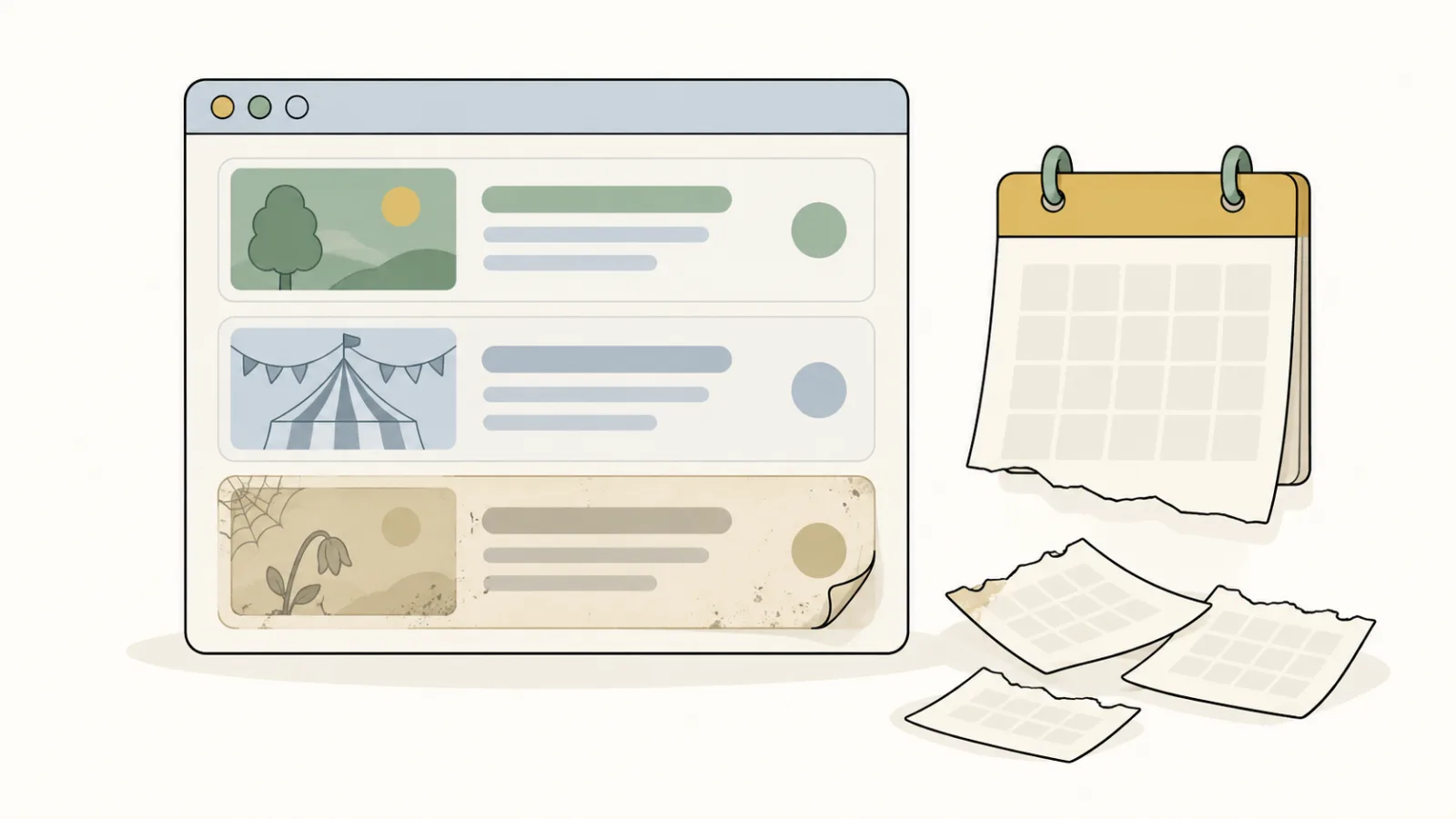
A past event still shown as open works like a wall calendar no one has turned since that month: accurate the day it went up, and a little more wrong every week after.
We counted four kinds of problem, written down before we opened the first site. Here is how often each one appeared on the 37 sites in the strict count.
21 of 37
An event, deadline or registration more than 30 days past, still presented as upcoming or open
9 of 37
An old year presented as current, such as last season’s schedule or registration
8 of 37
A news or blog section with nothing newer than two years
6 of 37
The site would not load securely, or a main menu link led to an error page
Among the 37 sites in the strict count. A site can show more than one, so the counts add up to more than 37.
Why a past event matters
A past event left on the page keeps inviting people to something that has already happened.
A shop that leaves last month’s sale sign in the window is still open. But the sign makes a passer-by wonder who is minding the store. A past event on a home page can raise the same question about a nonprofit.
Where donors look for information matters. The Give.org Donor Trust Report 2026 surveyed more than 1,500 US adults in December 2025, and 59% said they ask questions or look for information before giving. Among them, 54% named research on the charity’s own website as a source that influences their decision, ahead of third-party charity monitoring organizations (39%) and general web searches (35%).
A count from the outside cannot say why a site falls behind, and we did not try to. One outside survey gives a hint about the time involved: the Nonprofit Communications Trends Report 2025 surveyed 463 nonprofit communicators. Its chart of top challenges ranks a lack of time to produce quality content first, rated very or extremely challenging by 45%. (The report’s own text gives 44% for this item; we cite the chart.)
A five-minute check for your own site
These are the same four things we looked for. Open your site the way a stranger would and check:
- Every date on the home page. Is anything more than a month past still inviting people to come, register or apply?
- Every year in a heading. Does a schedule, season, program or form still carry last year’s year?
- The newest item in news or blog. If it is more than two years old, post something or take the section off the menu.
- Every link in the main menu. Click each one. Does any of them land on an error page?
If you find something, fix it this week. If you find several, it may help to make keeping the site current one named person’s job, ten minutes a week. Or let dates do the work: on the Harborlight Youth Arts sample site, events leave the list by themselves after their date. The other sample sites show more ways of letting dates run the page.
Turn the check into a schedule
What to look at every week, every quarter and once a year, built from these same numbers.
How often should a nonprofit update its website? →
See sample sites where dates run the page →
How we counted
Everything below is recorded in writing, so the count can be repeated. The source list is the IRS Exempt Organizations Business Master File.
Population
The IRS Exempt Organizations Business Master File for California, filtered to 501(c)(3) public charities that report revenue between $250,000 and $1,000,000: 10,799 organizations.
Sample
174 organizations drawn at random in two rounds, each with a recorded random seed, so the draw can be repeated exactly. Nothing was hand-picked or dropped.
Websites
We looked for each organization’s own site, not a social media page, a directory listing, a parent organization or a school district page. 21 had none. 3 returned a server error and could not be checked.
Signals
Four, written down before the first site was opened, then made more precise after a 44-site pilot; the pilot sites were classified again under the final rules. The four: a date more than 30 days past still presented as upcoming or open; an old year presented as current in an event, program or registration; a news section with nothing newer than two years; a site that would not load securely, or a main menu link that led to an error page.
Where we looked
The home page and the pages linked from it or from its main menu, at desktop width. Dates visible only inside images did not count, and neither did the footer copyright year.
Checking
The reference date was September 20, 2026. Sites were sorted by agents working to written rules; every out-of-date finding was then checked a second time: 55 against the words on the page, and 4 by reproducing the error. The strict count leaves out 22 cases judged borderline.
What this count cannot tell you
This count is a snapshot, not a film: each site as it stood on September 20, 2026. A count like this has edges, and they are worth stating plainly.
It covers California only. It looks only at the home page and the pages linked from it or its main menu, so a site we counted as current can still be out of date further in. The classification was done by agents working to written rules, and deciding what counted as borderline was a judgment, which is why the headline uses the strict figure. It measures what a visitor can see, not why a site fell behind or what it costs an organization. For the cost side, see what a nonprofit website costs each year.
We will not publish or share which organizations’ sites were out of date. The point of the count is the pattern, not the names.
Frequently asked questions
How many small California nonprofit websites are out of date?
In our count of 150 randomly chosen California charities with revenue from $250,000 to $1 million, 24.7% showed something plainly out of date, with a 95% interval of 18.5% to 32.1%. Counting borderline cases as well, the figure was 39.3%.
What is the most common sign that a nonprofit website is out of date?
An event, deadline or registration more than a month past that the site still presents as upcoming or open. 21 of the 150 sites we checked had one, about one in seven.
How was the sample chosen?
At random, from the 10,799 California 501(c)(3) public charities in the IRS Exempt Organizations Business Master File with revenue between $250,000 and $1 million. Both rounds used a recorded random seed, so the draw can be repeated exactly, and nothing was hand-picked or dropped.
Is the list of organizations public?
No. We publish totals only. The organizations did not ask to be studied, and naming them would not help anyone.
Why only California?
California is where connectNPO is based, and one state keeps the count consistent. Other states may show different results; we have not counted them.
Keeping a website current is our job.
connectNPO builds websites for small nonprofits and keeps them current, with every change made for you. You see the finished site before you pay the $1,000 build fee; after that it is one plan, $180 a month.
See the plan and apply →connectNPO’s own count, made on September 20, 2026, as described above. Totals only; no organization is named. Figures from other organizations are quoted from their reports as linked.