Year-End Giving Is Three Windows, Not One Campaign
connectNPO · Updated September 2026
Key takeaways
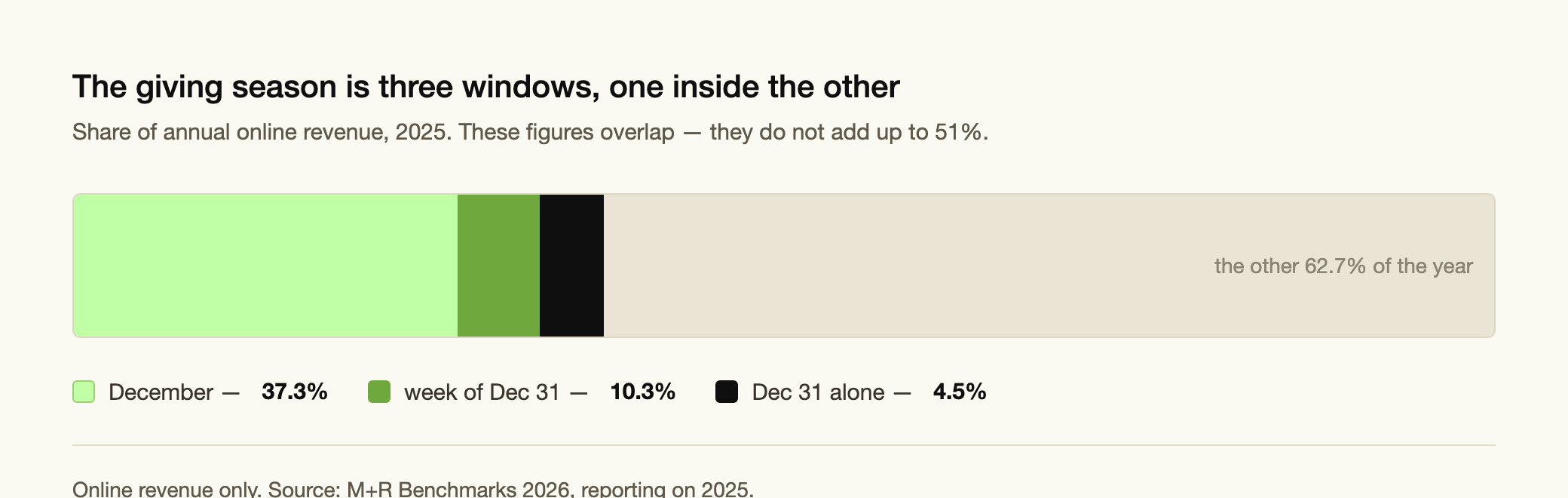
- In 2025, nonprofits raised 37% of annual online revenue in December, 10% in the week of December 31, and 4% on December 31 itself.
- Those windows did not move together. December revenue grew 11.5% year over year while GivingTuesday revenue grew 1.7%.
- Revenue from email fell in both — down 2.4% in December, down 5.0% on GivingTuesday — while organizations sent 13.6 messages per subscriber in December against roughly five in a normal month.
- Sector decides more than the average does: Public Media raised 26.9% of its online revenue in December, Hunger/Poverty 46.3%.
- These are online figures from organizations whose average digital team is six people. The shape transfers. The percentage does not.
Year-end giving is three windows, not one campaign
It is the third week of November. The appeal still needs a second paragraph. The donation page still has last year’s photo on it. The person writing the appeal is the same person updating the page, and also the person who answers the phone. Somewhere in an open browser tab is an article explaining that a third of all giving happens in December, which is either encouraging or the most stressful sentence you will read this quarter.
We want to make that sentence useful instead of alarming, because the number behind it is real but it is doing something more specific than it looks. Year-end giving is not one push with one deadline, and the 2025 data shows why that distinction decides how a small team should spend December.
Source: M+R Benchmarks 2026, reporting on 2025. These three figures are nested, not additive — December 31 sits inside the final week, which sits inside December.
Two things about that 37% before anyone builds a plan on it. It is online revenue only. In the same study, for every dollar raised online, participating organizations raised another $0.66 through direct mail. So the figure describes a share of one channel, not a share of everything an organization brings in. And the organizations reporting it have, on M+R’s own account, an average digital team of six people.
Read the scope before the number
If your digital team is one person who also does program reporting, this is not your number. It is a useful picture of the shape of the season, and the shape is what transfers. Treat the percentage as somebody else’s weather report, not your forecast.
The shape is this: the giving season is not one campaign. It is three windows sitting inside each other, and in 2025 they behaved so differently that treating them as a single push is the thing that quietly wastes a small team’s December. A kitchen can cook one seating properly or three of them cold. The question is not whether your organization should show up in December. It is which of the three windows you are actually going to staff.
The windows did not move together
Nearly every year-end guide opens the same way: use GivingTuesday to launch or boost the campaign. In 2025 that was not where the movement was.
December, 2024 → 2025
+11.5% overall
−2.4% from email
GivingTuesday, 2024 → 2025
+1.7% overall
−5.0% from email
Year-over-year change in revenue, not share of the year. Source: M+R Benchmarks 2026.
December grew almost seven times faster than GivingTuesday did. And in both windows, the revenue that came through email went down while total revenue went up. That is one year and one panel of organizations, so it is not a verdict on GivingTuesday. It is a reason to stop assuming the three windows are one thing that rises and falls together. They plainly did not.
Your sector narrows the choice
The 37% average hides a spread wide enough to change what a reasonable plan looks like.
Share of annual online revenue. Source: M+R Benchmarks 2026.
Read the two columns together and the sectors separate into different seasons. Hunger and Poverty organizations raised the largest December share of anyone, 46.3%, but only 8.1% in the closing week — their money arrives earlier in the month. M+R points to the period around Thanksgiving, which has long mattered for food banks. Rights organizations raised a very ordinary December share, 37.2%, but 15.7% of their entire online year landed in the last seven days. Same season. Almost opposite shapes.
Public Media is the case worth sitting with. It raised the smallest December share of any sector, 26.9%, and the smallest final-week share, 5.5%. It also recorded the largest December swing of any sector. M+R reports a 32% increase in Public Media December revenue against 11.5% across all organizations, and connects that response directly to the year in which federal funding for the Corporation for Public Broadcasting ended. The sector that depends least on December had the biggest December. Concentration and momentum are not the same measurement, and a plan built on the wrong one aims at the wrong week.
What the crowding costs
There is a reason a bigger December push does not reliably produce a bigger December. Everyone else is pushing too, and the increase is not small.
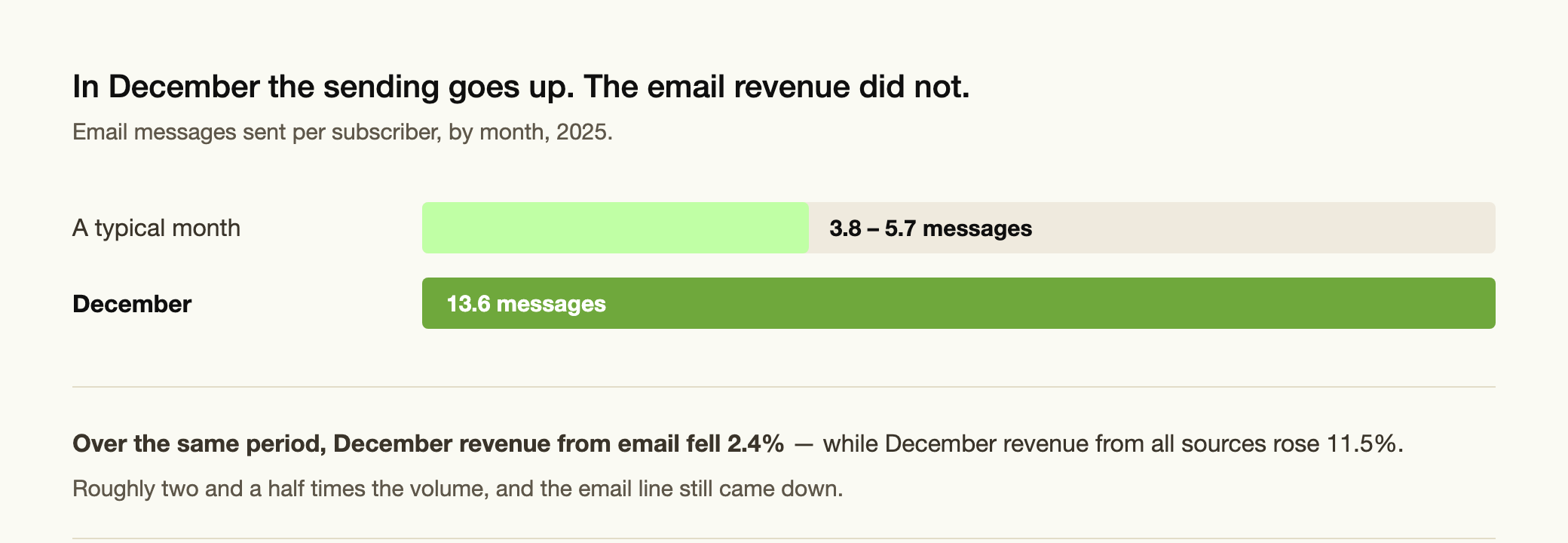
In December, participating organizations sent 13.6 email messages per subscriber. In other months the figure sits between 3.8 and 5.7.
Search advertising in December alone accounted for 9.8% of the entire year’s digital advertising budget, against roughly 1.5% in a typical month.
Source: M+R Benchmarks 2026, reporting on 2025.
That is nearly three times the email and roughly six times the search spend, both calculated from the figures above. Over the same month, revenue from email came down 2.4%. What to do inside that constraint is its own subject, and our guide to nonprofit email marketing covers deliverability and cadence. December is the month when your own effort rises and your share of a donor’s attention can still fall, because every organization they support is doing the same thing in the same week.
This is not an argument for sending less into a season that genuinely carries a third of the online year. It is an argument against the plan that has one staff member producing three campaigns in six weeks on the theory that more surface area means more revenue. The 2025 figures do not show that trade paying off: volume went up and email revenue went down. They do not prove the volume caused the decline, and we would not claim that. They do remove the assumption that more sending is reliably more money.
Pick one window and staff it
Here is the version that fits a team that does not have six people on digital. Five steps, run in one week of concentrated work rather than spread thin across eight.
Name the window and write the dates down
GivingTuesday, the body of December, or the closing week. One of them. If your cause draws attention around Thanksgiving, that argues for the early window; if your donors are habitual last-week givers, it argues for the last.
Decide what the other two windows get
A single send, or nothing at all. Nothing is a legitimate answer and it is better than a rushed campaign that reuses a subject line you did not have time to think about.
Fix the donation page before you write the appeal
Every message you send in the window lands on the same page. Improving the page improves all of them at once; improving one email improves one email. This is the kind of work the website plan exists for.
Write the thank-you before the ask
Draft it in the same sitting, and make sure it goes out inside the same week. M+R puts new donors at 31% of online revenue in 2025, and separately reports online one-time donor retention of 24% for new donors, against 66% for donors who had already given more than once. A December first gift is the least secure kind you can receive. Our post on donor retention covers what happens after.
Track gifts, not dollars, while the window is open
One large gift can hide a week of silence in a dollar total. The count tells you whether the campaign is working while you can still change it.
If your organization is new or very small, take the first three and leave the rest until next year. A short list you run in one week beats a complete list you abandon on December 18.
What October decides that December cannot
M+R is clear about where the 2025 growth came from, and it is not a comfortable answer for planners. Online revenue from one-time gifts rose 17%, outpacing the 12% growth in monthly revenue. M+R calls that a clear break from the long-term trend and reads it as donors responding to a year of emergencies. That is the part of a year nobody can schedule.
What you can schedule is the standing machinery underneath it. Monthly giving accounted for 27% of all online revenue in 2025, and revenue from donor-advised funds rose 44%. Neither a sustainer signup nor a donor-advised fund gift is created by an appeal in the last week of December; both depend on arrangements that either exist by October or do not. You cannot make sourdough on Friday for Friday. The starter had to already be alive.
Source: M+R Benchmarks 2026, reporting on 2025. Online revenue only.
Before the season starts
- Is there a working monthly giving option on the donation page, described in one sentence?
- Can a donor-advised fund gift reach you without a phone call?
- Does the receipt that goes out automatically say something a person would want to read?
- Is there one page on the site that explains what a gift does, that you would be willing to send to a stranger?
If you are answering no to all four, start with the first one only. A working monthly option is the single item on this list that keeps paying after the season ends, and the other three will still be here next October.
One more thing to hold loosely while planning this year. The Fundraising Effectiveness Project reported total giving up 4.3% year over year in its Q1 2026 report, down from 5.4% and 10.4% in the two prior readings. Its own summary is careful about why:
Growth remains strong, but some of it was likely borrowed from a hot Q4.
Fundraising Effectiveness Project, Q1 2026 report
FEP describes part of that late-2025 strength as pulled forward rather than newly generated. The practical consequence is narrow and worth stating plainly: if you set this year’s year-end target by taking last year’s result and adding a percentage, you may be building on a baseline that was inflated by timing. Compare against two or three years, not one. If you are putting the whole year on paper rather than only the last six weeks, our guide to building a nonprofit fundraising plan works through the numbers a plan has to name.
This article is about running a year-end campaign. It does not cover the donor side of year-end giving — deductions, timing rules, or how any particular gift is treated. connectNPO does not provide legal, tax, accounting, or Form 990 advice; those questions belong with your accountant or counsel.
Not sure which window your organization should be staffing?
We can look at what your last two Decembers actually did and help you choose one window to run properly this year.
Frequently asked questions
What percentage of donations come in at year end?
M+R Benchmarks 2026 reports that nonprofits received 37% of annual online revenue in December 2025, with 10% arriving in the week of December 31 and 4% on December 31 itself. Those figures are nested rather than additive, and they describe online revenue only. In the same study, organizations raised another 66 cents through direct mail for every dollar raised online, and M+R publishes no month-by-month timing for direct mail. So the December share of an organization total revenue is not known from these figures, and 37% should not be read as a share of everything that comes in.
When should a year-end campaign start?
Earlier than the sending does. Monthly giving made up 27% of online revenue in 2025 and revenue from donor-advised funds rose 44%, and neither a sustainer signup nor a donor-advised fund gift can be created by an appeal in the final week. M+R attributes the growth itself mostly to one-time giving, which rose 17% against 12% for monthly revenue, so treat the December surge as the part you cannot schedule and the standing arrangements as the part you can. A practical sequence is to have the donation page, the monthly option and the automatic receipt working by the end of October, then concentrate the writing and sending into the single window you have chosen.
Is GivingTuesday worth it for a small nonprofit?
It depends on whether it is the window you can staff. In 2025 GivingTuesday revenue grew 1.7% year over year while December revenue overall grew 11.5%, and revenue from email fell 5.0% on GivingTuesday. That is a single year from one panel of organizations, so it is not evidence that GivingTuesday has stopped working. It is a reason not to assume it is the strongest of the three windows by default, and not to run it as well as a full December campaign if one person is doing both.
How many emails should we send in December?
There is no benchmark that answers this for an organization of your size, and we would rather say so than invent one. What the 2025 data shows is that participating organizations sent 13.6 messages per subscriber in December, against 3.8 to 5.7 in other months, and December revenue from email still fell 2.4%. More volume did not produce more email revenue that year. Decide the number by what you can write well inside your chosen window rather than by matching a benchmark set by organizations whose digital teams average six people.
Does this article cover the tax side of year-end giving?
No, and that is deliberate. Searches for year-end giving mix two different readers: nonprofit staff planning a campaign, and donors asking how a gift is treated. This article is written for the first group only. connectNPO does not provide legal, tax, accounting, or Form 990 advice, so questions about deductions, timing rules or the treatment of any particular gift should go to your accountant or counsel.