Nonprofit Impact Report Examples: Eight Impact Pages You Can Open
connectNPO · Updated September 2026
Key takeaways
- A nonprofit impact report earns trust through how each number was counted, not through its design. Put a sentence under every figure that says who was counted, over what period and from which record.
- The eight examples below are impact pages on connectNPO’s sample sites, for invented organizations from a youth arts program to a food pantry. Six put a counting method under every number; each page can be opened and read.
- Say what you cannot prove. Four of the eight samples state plainly which outcomes they do not measure, such as grades or what the food did. Harborlight adds that it will not borrow another organization’s study.
- The numbers on an impact page can be the ones your Form 990 already asks for: the IRS instructions ask for program accomplishments in specific measurements, such as people served or sessions held.
- In a Give.org survey of US adults, 53.1% named accomplishments shared by the organization as one of three signals that a charity is trustworthy, ahead of financial ratios at 27.5%.
The grant report is due, and the funder’s form asks for outcomes. You have numbers from the year, but each was counted a little differently, and no one wrote down how.
Search for nonprofit impact report examples and you find large charities with designed reports: bold photography, a hero statistic on the cover, a few pages of stories. They look good. For a small organization they can also be hard to copy, because they depend on a design budget and on a year of material gathered in one place.
The examples below take a different approach. They are impact pages on connectNPO’s sample sites, built for eight kinds of small nonprofit. The organizations are invented; the pages are real, and each one can be opened. What they share is not a look but a habit: every number says how it was counted.
What should a nonprofit impact report include?
A nonprofit impact report should give a few numbers about the year, a sentence under each one saying how it was counted, a plain statement of what the organization cannot prove, and one thing that did not work. Linking to the financials lets a reader see the money beside the results.
The numbers
Three to six figures for the year.
How each was counted
One sentence under each figure: who, how, when, from which record.
What we cannot prove
The outcomes you do not measure, said plainly.
What did not work
One thing, and what changes next year.
Eight impact report examples, compared
The table sets the eight side by side. Six put a counting method under every number. Four say what they cannot prove. One, the theater’s page, shows only where the money went. That is useful on its own, and set beside the other seven it shows how much a counting line adds.
| Sample | Headline numbers | Method under each number | Says what it cannot prove | Money on the same page |
|---|---|---|---|---|
| Harborlight Youth Arts youth arts program · page: Impact | 1,140 young people · 62% came back | Yes, with a source for each | Yes, plus one thing that did not work | Linked |
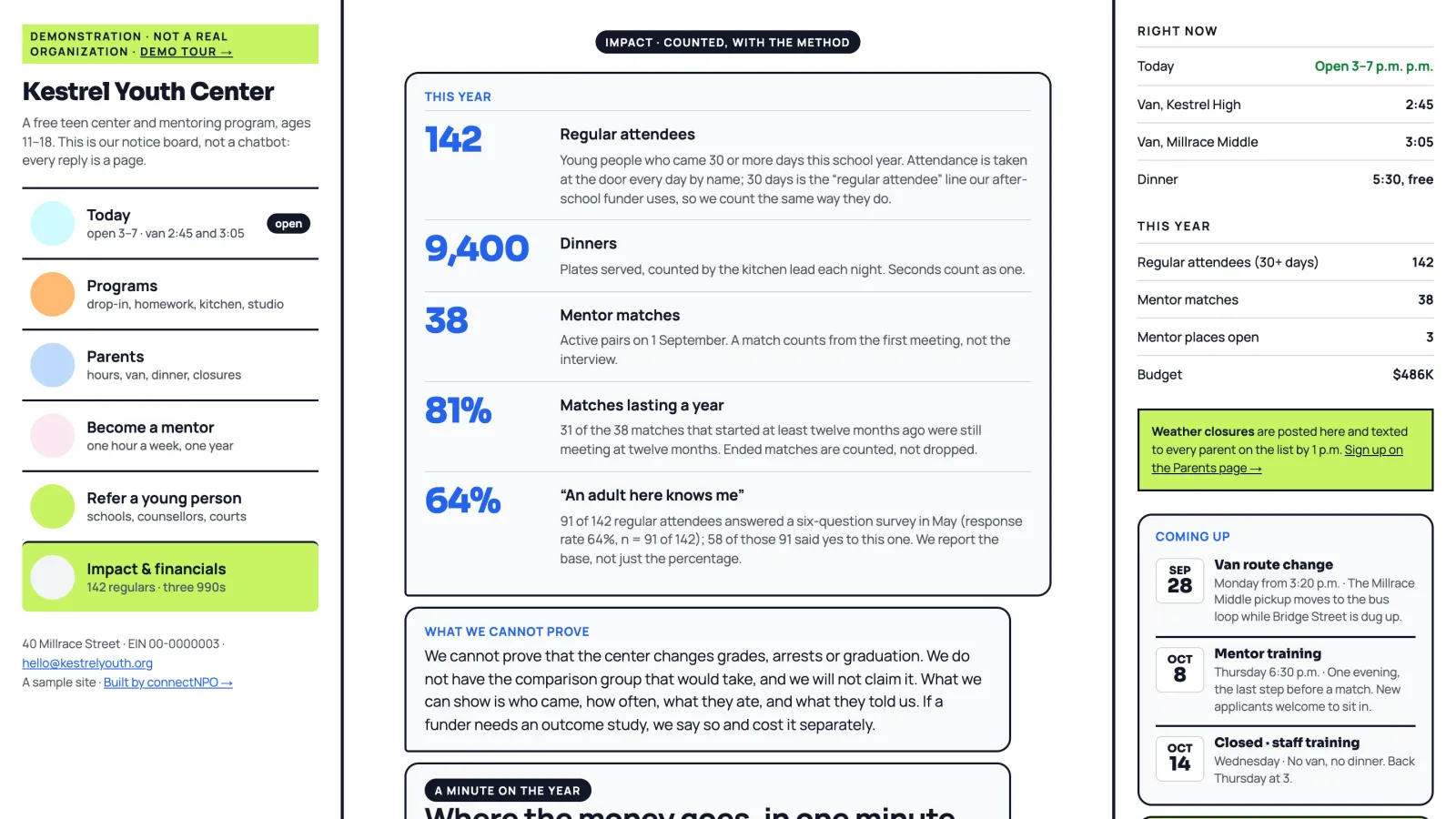
| Kestrel Youth Center teen center · page: Impact & financials | 142 regular attendees · 31 of 38 matches lasted a year | Yes | Yes | Yes |
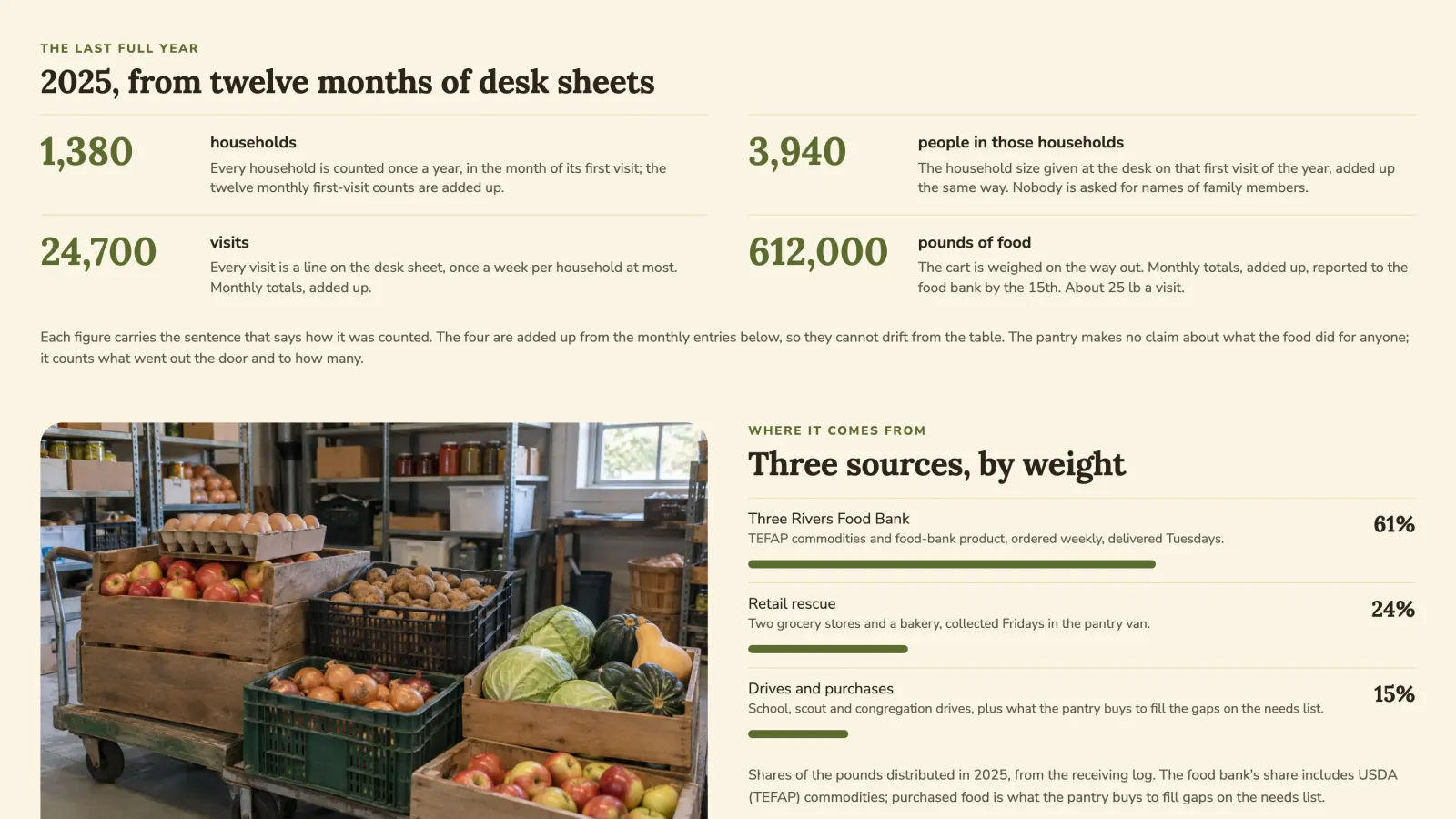
| Quarry Road Food Pantry food pantry · page: Numbers | 1,380 households · 612,000 lb of food | Yes, added up from the months | Yes | Linked |
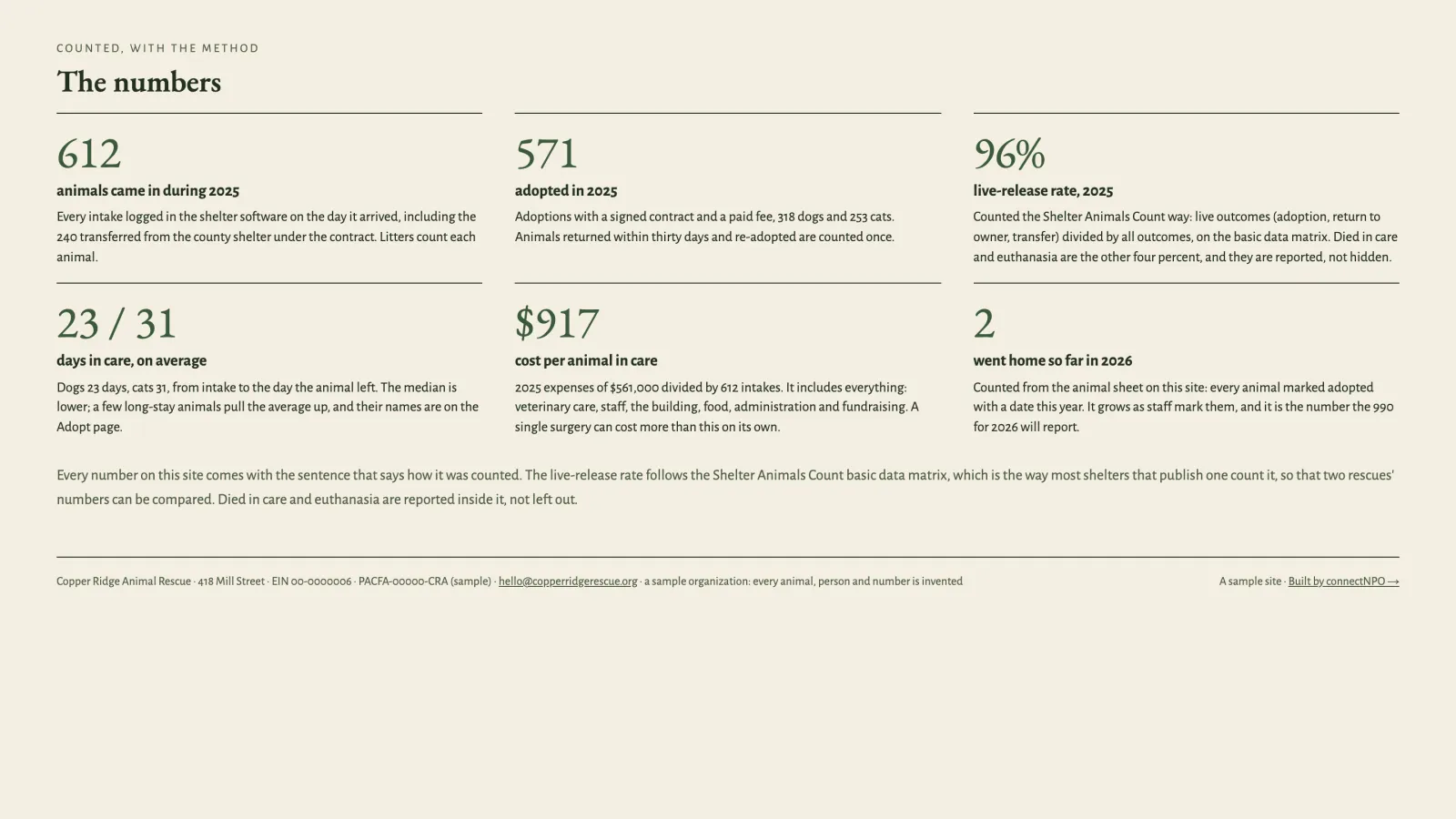
| Copper Ridge Animal Rescue animal rescue · page: Financials | 96% live-release rate · $917 per animal | Yes, on a published data standard | No | Yes |
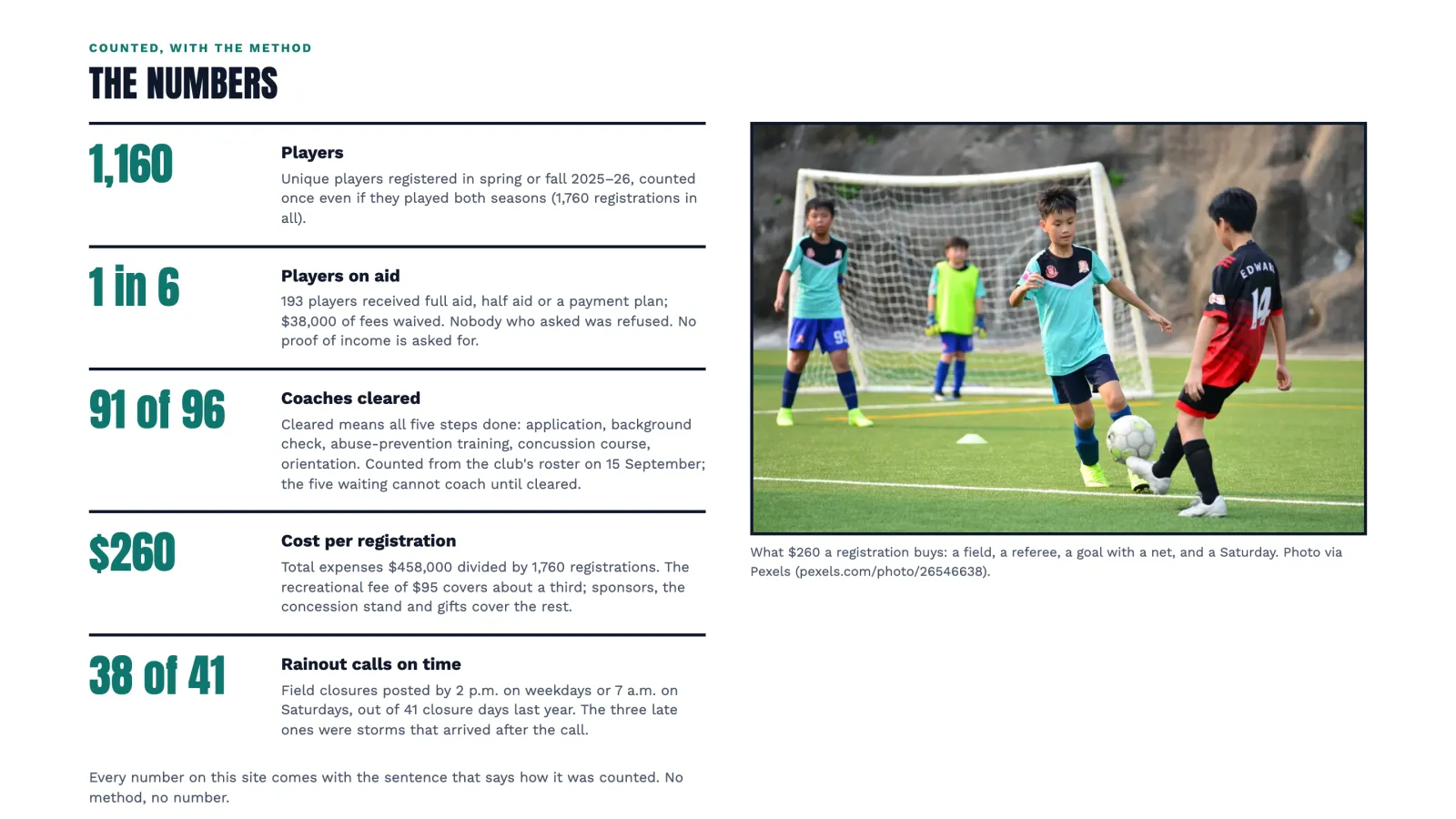
| Tenmile Youth Soccer Club youth soccer club · page: Financials | 1,160 players · $260 per registration | Yes | No | Yes |
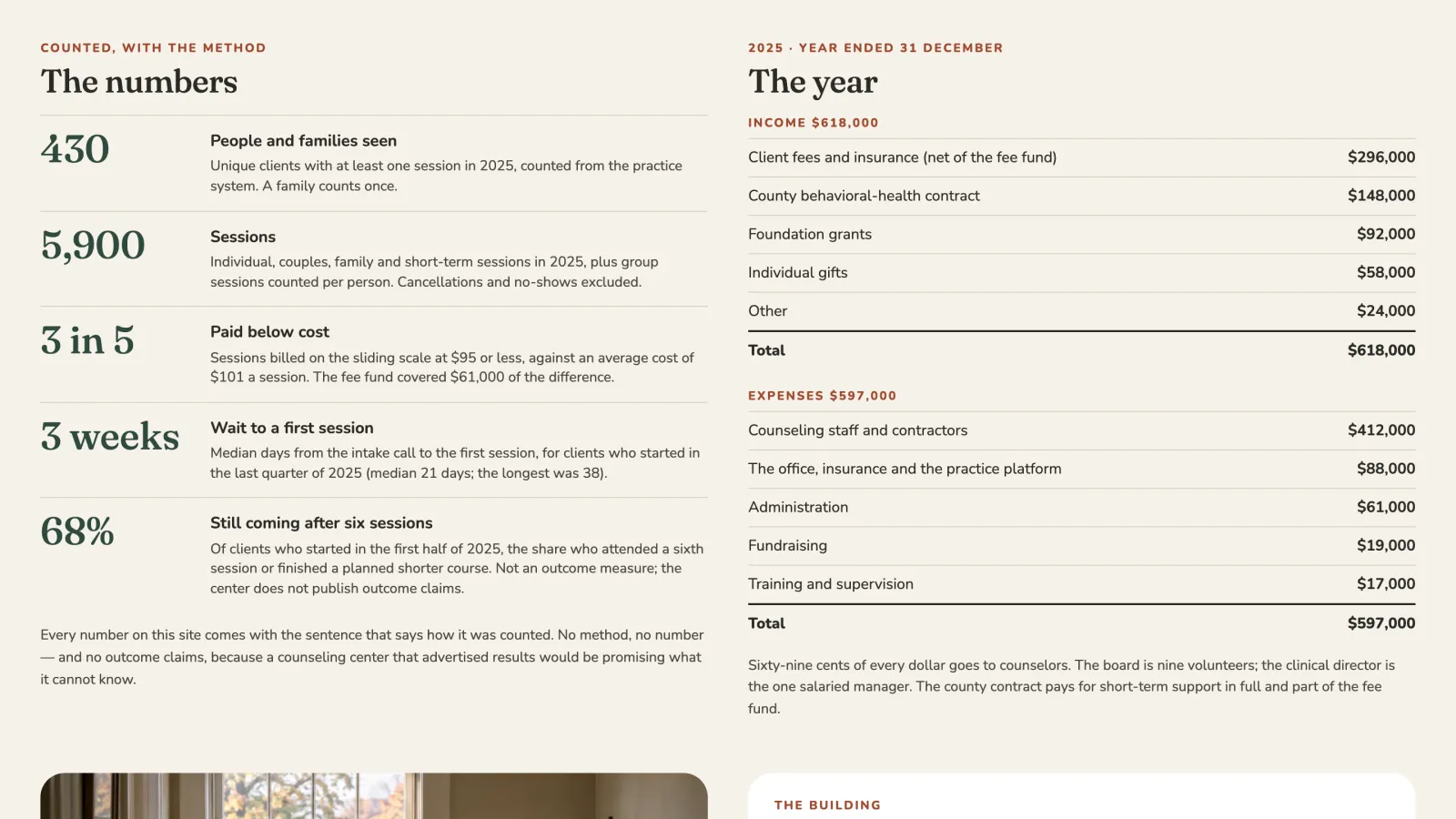
| Larkspur Family Counseling counseling center · page: Give & financials | 3-week median wait · 68% still coming after six sessions | Yes | Yes: no outcome claims | Yes |
| Wren Valley Scholarship Foundation scholarship fund · page: Recipients | 268 awards · $894,500 paid | Totals added up from the award list | No | Linked |
| Old Ferry Playhouse community theater · page: About & financials | $418K in · $402K out · 55% on productions | No: money only | No | Yes |
Read from the live sample pages on September 22, 2026. The organizations and their figures are invented; the pages are real. “Linked” means the financials are one click away.
Every number with how it was counted
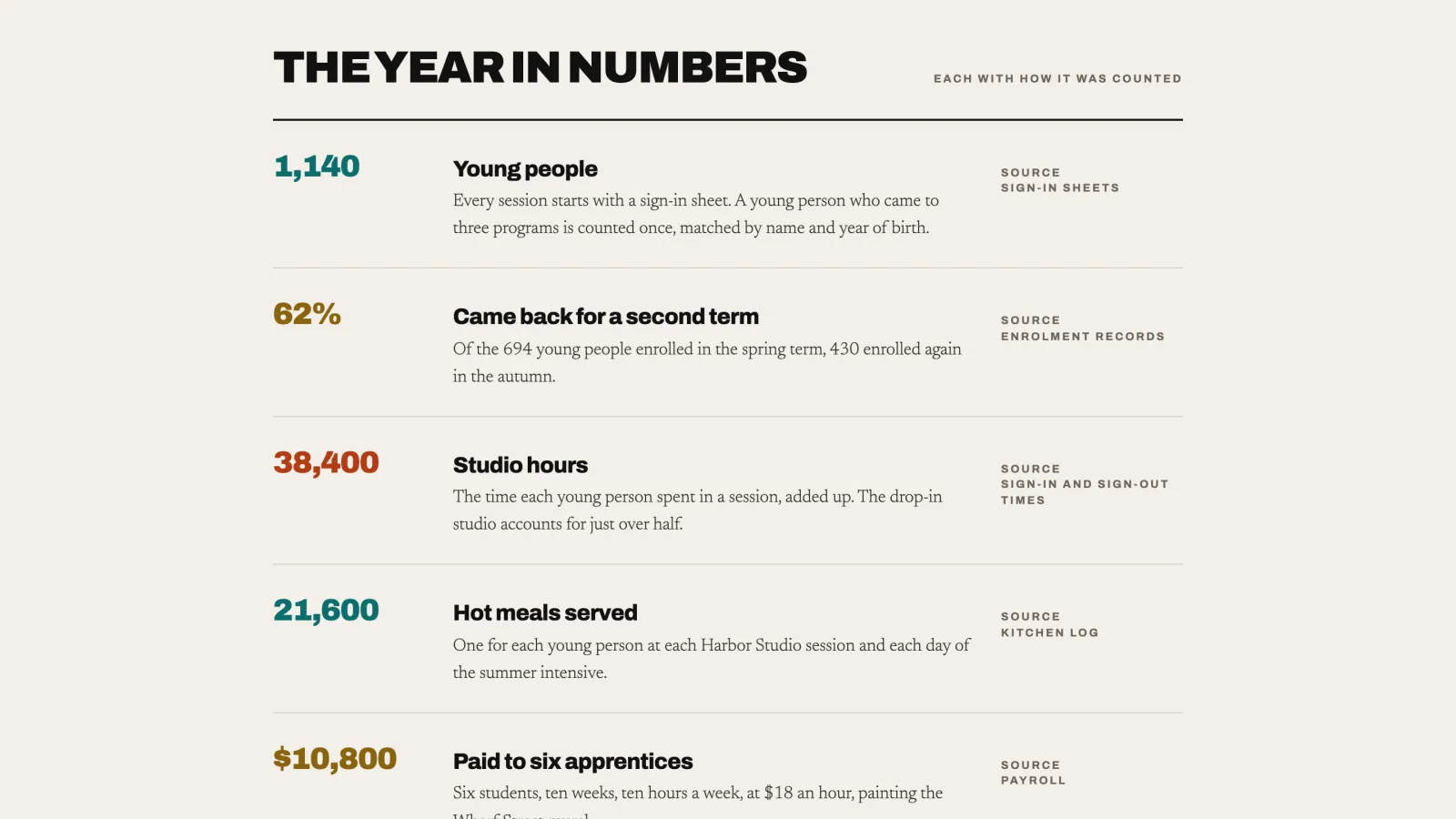
A food label does not just say “protein”. It says how much, per serving. A number on an impact page works the same way: “1,140 young people” means little until you know whether a young person who came to three programs was counted three times.
One number, fully labeled
1,140
young people, 2025 (Harborlight Youth Arts, sample)
Each sample answers that question under the figure itself. Harborlight Youth Arts counts a young person once, matched by name and year of birth, from the sign-in sheets. Kestrel Youth Center counts 142 regular attendees, using the line its after-school funder uses, 30 or more days in the school year, so it counts the same way the funder does.
Quarry Road Food Pantry counts each of its 1,380 households once a year, in the month of its first visit, and weighs every cart for its 612,000 pounds. Copper Ridge Animal Rescue reports a 96% live-release rate built from the data points in the Shelter Animals Count intake and outcome standard (formerly the Basic Data Matrix), a published data standard, and shows the math behind its $917 cost per animal: $561,000 of expenses divided by 612 intakes. Tenmile Youth Soccer Club does the same for its $260 cost per registration.
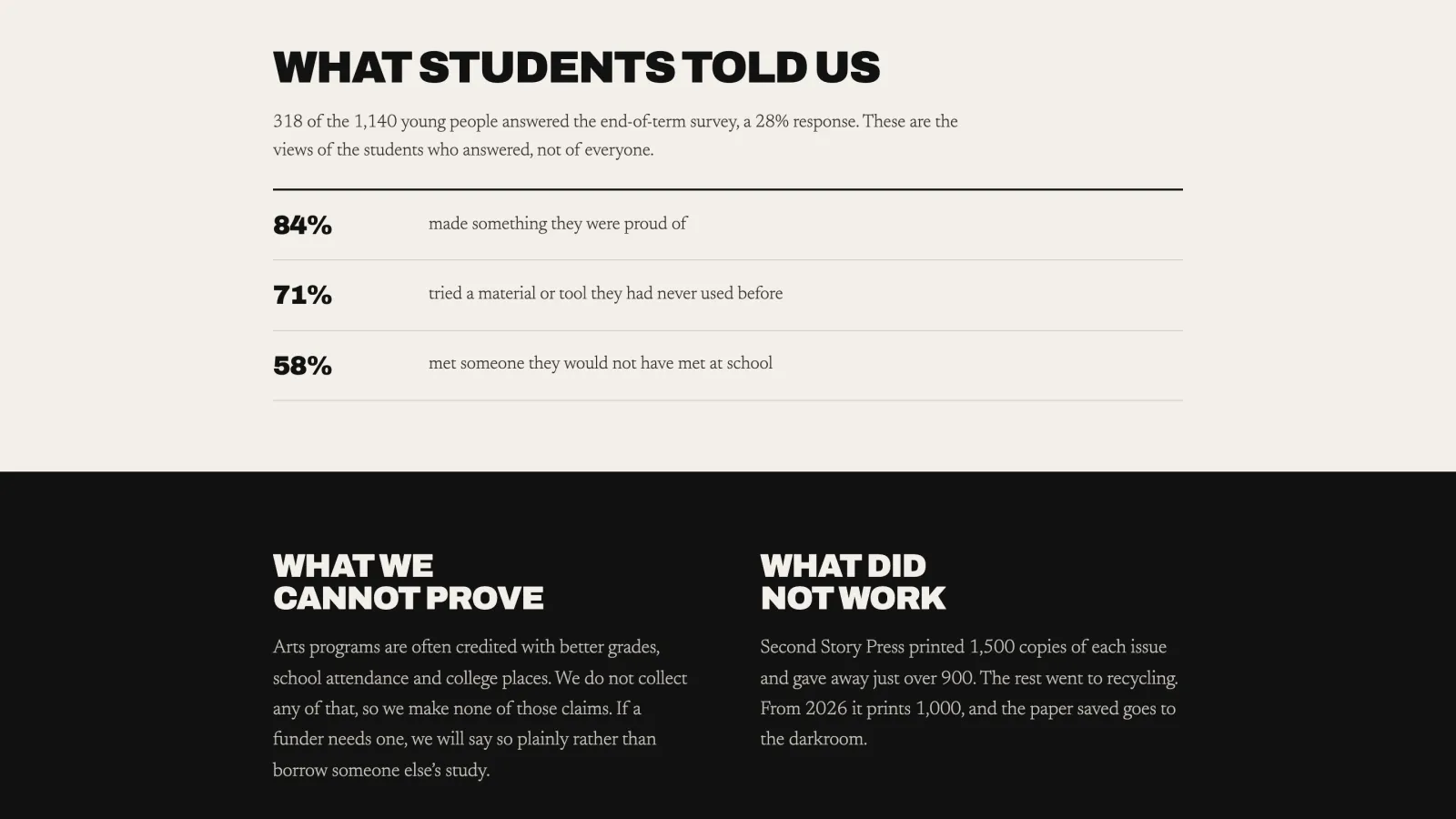
Where a number comes from a survey, the samples say how many people answered, not only the percentage. Harborlight says 318 of its 1,140 young people answered, a 28% response, and that the results are the views of those who answered.
Say what you cannot prove
Saying what you cannot prove works like the percent chance of rain in a weather forecast: being honest about the uncertainty is what makes the rest believable.
The hardest line on an impact page to write is the one that says what the organization does not know. It answers a question a careful reader may have.
Four samples write it. Harborlight says arts programs are credited with better grades and college places, that it does not collect any of that, and that it makes none of those claims. Kestrel says it cannot prove the center changes grades, arrests or graduation, because that would take a comparison group it does not have. The pantry counts what went out the door and makes no claim about what the food did. The counseling center, Larkspur Family Counseling, publishes no outcome claims at all, and labels its “68% still coming after six sessions” as not an outcome measure.
Saying this does not weaken the page. It gives a funder a reason to trust the other numbers on it.
One thing that did not work
Harborlight’s page has a section called “What did not work”. Its student press printed 1,500 copies of each issue and gave away just over 900; from 2026 it prints 1,000. Next to it sit three goals for the coming year, each with the change that should move it, such as a paper survey at the last session instead of an email afterwards.
One honest shortfall, with what changes, reads as an organization that measures itself. It also gives next year’s report something to check.
An Impact page comes with every connectNPO site
We build it with you and update it once a year with your new numbers, as part of one plan at $180 a month.
The same numbers as your Form 990
An impact page does not need numbers invented for it. The Form 990 instructions ask an organization to describe its accomplishments for each of its three largest program services, as measured by total expenses, and to do it through specific measurements such as people served, days of care provided, sessions or events held, or publications issued.
Those are the same kind of figures an impact page shows. Two samples, the teen center and the theater, say so on the page: “These are the figures in the 990 below; if a number here ever disagrees with the filing, the filing is right.” When the page and the filing come from the same records, they are much less likely to drift apart. connectNPO does not prepare or advise on the 990; your accountant or preparer does.
For the whole list of pages a nonprofit site should carry, the impact page among them, see what should be on a nonprofit website.
A page you keep current, not a PDF you design once
A designed report is a photograph of the year. An impact page is a window you keep clean.
A designed annual report is a finished object: it is printed or saved as a PDF, and it stays as it was. Annual report design has its place. An impact page on your own website does a different job. It can be updated when the year closes, it links to the filings, and a funder who finds it in March sees last year, not the year before.
In a Give.org survey of more than 2,200 US adults (December 2023), asked to choose three factors that most signal a charity is trustworthy, 53.1% chose accomplishments shared by the organization, ahead of third-party evaluation at 36.1% and financial ratios at 27.5%. An impact page on your own site is one place to share those accomplishments, with the counting shown.
On two of the samples, staff enter the underlying records, such as an award or a month of desk sheets, and the totals are added up from them; the pantry’s year is the sum of its months. The Wren Valley Scholarship Foundation page lists 268 awards and $894,500 paid, and both figures come from the award list itself. How that works on a WordPress site is in WordPress for nonprofits.
Open the impact pages
The six captures below each open the sample page they show, and the table above links all eight; all eight sites are listed on our sample sites page. Read the line under each number, then look for the one that says what the organization cannot prove.
Frequently asked questions
What should a nonprofit impact report include?
A few numbers about the year, each with a sentence on how it was counted and from which record, a plain statement of what the organization cannot prove, one thing that did not work, and goals for next year. A link to the financials puts the money beside the results.
How is an impact report different from an annual report?
An annual report covers the whole organization for a year, and can include the financial statements and a list of supporters. An impact report covers results: what the programs did and how that was counted. A small organization can publish both on its own website.
Where do the numbers for an impact report come from?
From records the organization already keeps, such as sign-in sheets, enrollment records, a kitchen log, payroll or a food bank report. The Form 990 instructions ask for program accomplishments in specific measurements, so the same figures can serve both.
Should a small nonprofit report outcomes it cannot measure?
No. Report what you counted and say plainly what you do not measure. Four of the eight sample pages do exactly that, for example by saying they do not collect grades, instead of citing a study about other programs.
Can we see these impact pages working?
Yes. They are on connectNPO sample sites for invented organizations, and every page can be opened. On two of them, the scholarship fund and the food pantry, staff enter the underlying records and the totals are added up from them.
See your finished website before you pay for it.
Your Impact page is part of it. You pay nothing until you approve the finished site; the first payment is then $1,180 (the build fee plus the first month), and $180 a month after that.
See the plan and apply →The eight organizations are fictional samples built by connectNPO; their figures are invented. Pages were read on September 22, 2026. This guide is general information, not tax, legal or accounting advice.