Nonprofit AI Visibility: What ChatGPT Says When Someone Asks About Your Nonprofit
connectNPO · Updated October 2026
Key takeaways
- Nonprofit AI visibility is how accurately an AI assistant such as ChatGPT identifies and describes your organization when someone asks about it by name: the right organization, your own website and your own words. We tested it on 130 small US nonprofits in ChatGPT on October 27, 2026.
- ChatGPT picked the right organization for all 130 when given its name, city and state. For the 100 whose tax return (Form 990) lists a website, it gave that organization’s own site in 98 answers, and the site was the first source cited in 76.
- Answers also leaned on nonprofit lookup sites: 74 of the 100 cited at least one built on IRS filings, led by Cause IQ, ProPublica’s Nonprofit Explorer, Charity Navigator and philanthropy.org. These sites republish what an organization files with the IRS.
- Of 30 organizations whose 990 lists no website, ChatGPT found a working site or page of their own for 17 (two of them pages on a parent body’s site). For 11 it gave no website of their own; 10 of those answers cited a nonprofit lookup site built on IRS filings.
- Blocking was rare in our panel: 3 of 586 small nonprofit sites we checked tell OpenAI’s search tool to stay out. The name test in this guide takes about five minutes and shows how your own organization reads in an answer.
Picture the evening before a site visit. Suppose a program officer at a community foundation has your organization’s name in an email and twenty minutes to prepare. They type your name and town into ChatGPT and ask what you do.
What comes back was not written by you, and unless you ask the same question yourself, you will not see it. It reads like a reference letter from someone who has never visited: polite, confident, and put together from whatever was on the desk, which might be your website or might be a tax form.
If you wrote your About page between a grant report and a board meeting, checking how it reads in an AI answer was never on the list.
We wanted to know what that letter says for small nonprofits. So we asked ChatGPT about 130 of them and read every answer against what each organization files and publishes. The short version: ChatGPT will say something about you. The question is whose words it uses. That is nonprofit AI visibility, and you can check it.
What is nonprofit AI visibility?
Nonprofit AI visibility is how accurately an AI assistant such as ChatGPT identifies and describes your organization when someone asks about it by name: the right organization, your own website and your own words.
Three parts, each one you can check. The right organization: not a similarly named group two states away. Your own website: the address you use today, not a lapsed domain or a directory listing. Your own words: the description sounds like your About page, not a single sentence typed into a tax form years ago.
It sits next to search. Nonprofit SEO asks whether people find your site when they search for what you do. AI visibility asks what an assistant says when someone already knows your name and wants to know if you are real, what you do and where to give. That is a moment a funder, a board candidate or a donor may reach before saying yes.
How we tested 130 small nonprofits in ChatGPT
We drew two random samples from our national panel of small US public charities, meaning 501(c)(3) organizations with $250,000 to $1 million in revenue. The panel comes from the IRS list of tax-exempt organizations and is the same one behind our nonprofit website statistics.
100 organizations whose latest Form 990 lists a website that loaded when our panel visited it in October 2026, and 30 whose 990 lists no website, as a comparison. For each, we asked ChatGPT with web search on, once, the same question: Tell me about [name] in [city, state]. What does it do, and what is its website? We used the name as filed with the IRS.
Then we read every answer against the organization’s 990 and its home page. Did it pick the right organization? Did it give the organization’s own website? Which sources did it cite? A second, independent coding pass, done by an AI agent working from the same written rules without our codes, recoded 20 answers drawn at random and agreed with ours on identification and website in all 20. It also checked every factual claim in those 20 answers against the 990 and the home page.
The answers were collected on October 27, 2026. We tested one assistant (ChatGPT with search), one question and one run per organization; other assistants, such as Google AI Mode, Perplexity, Claude and Copilot, were not tested. We also tested by name only. Whether an assistant recommends you when someone asks by cause or place is a separate question.
Does ChatGPT know small nonprofits? Yes, by name
All 130 answers described the right organization, including the 30 with no website on their 990. Given a name, a city and a state, ChatGPT did not describe any of them as a similarly named organization elsewhere, though one answer gave such an organization’s website (see below). For the 100 with a website, it gave the organization’s own address in 98 answers. One answer said it could not confirm a website; one named a domain that no longer loads.
It also kept up with change better than the paperwork. In 8 of the 100, the website on the 990 no longer led straight to the organization: 7 redirected to a new address after a name change, a domain move or a move to a hosted platform, and 1 had lapsed. All 8 answers gave the current address.
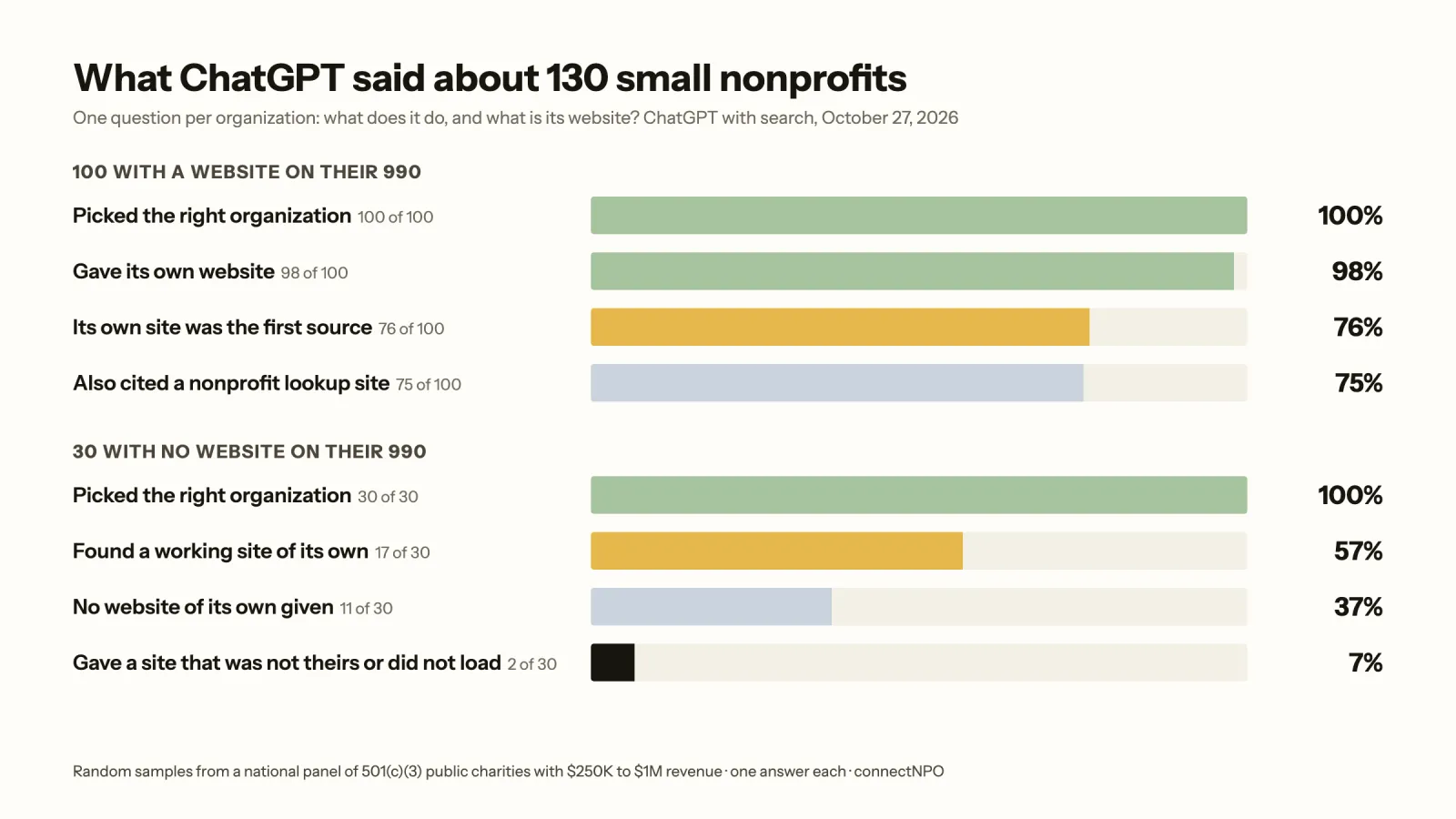
If you have been quietly worried that ChatGPT has never heard of an organization your size, this is good news: when someone asked by name, in our test, it had. Being found by name is the easy part. What the answer says once it has found you is where organizations differ.
Where ChatGPT gets what it says about your nonprofit, and what it cites
Across the 100 answers about organizations with a website, ChatGPT cited 627 sources. More than half were pages on the organization’s own site, and the own site was the first source in 76 answers.
| Source cited | Citations | Share |
|---|---|---|
| The organization’s own website | 348 | 55.5% |
| Everything else (local news, government, partner, event and other sites) | 137 | 21.9% |
| Nonprofit lookup and directory sites (Cause IQ, ProPublica, Charity Navigator and others) | 127 | 20.3% |
| Social profiles (LinkedIn, Facebook) | 15 | 2.4% |
The second voice is your tax return. In 75 of the 100 answers, ChatGPT listed at least one nonprofit lookup or directory site as a source, and in 74 at least one built on IRS filings: Cause IQ in 33, ProPublica’s Nonprofit Explorer in 31, Charity Navigator in 29 and philanthropy.org in 22. Each republishes data from what an organization files with the IRS; several show a description taken from the return, and ProPublica links to the full filings.
Think of the 990 as the catalogue card and your website as the book. In our answers, ChatGPT cited the book first in 76 of 100 when there was one, and leaned on the card when there was not.
In the 20 answers checked claim by claim, 163 claims matched the 990 or the home page, 2 contradicted them and 73 could not be checked against either. The 2 contradictions were a phone number and a date (tax-exempt since 2012 against founded in 2014); none was about what the organization does.
That is the reframe. In the answers we checked, ChatGPT was not inventing small nonprofits. For organizations with a website, it was retelling them, with 55.5% of all cited sources on their own sites, and filling gaps from lookup sites built on their tax returns. When a site exists, it is the most-cited kind of source across the answers: 348 of 627 citations. If you are writing those pages now, what should be on a nonprofit website and our mission statement examples cover the sentences an assistant leans on.
Want to see what plain, quotable pages look like? Press through fifteen sample sites, each stating its name, place and work in its own words.
No website: your tax filing speaks for you
The 30 organizations whose 990 lists no website tell the rest of the story. For 17 of them, ChatGPT gave a working web address for the organization anyway, and we checked that each one loads (one only with www. in front); two are the organization’s own page on a parent body’s site, and one we matched by town and purpose because the site does not print the legal name. More than half of the “no website” group had a working web address; the website line on their return was blank or said none.
For the other 13, the result was weaker. 11 answers gave no website of the organization’s own: 9 said they could not verify one, and 2 offered a related organization’s or the city’s page instead. 10 of the 11 cited a nonprofit lookup site, and 4 told the reader that the description came from the organization’s filings or nonprofit records. 2 gave a website that was wrong: one belonged to an unrelated organization with a similar name, and one was an old domain that no longer loads.
It is like being introduced at a gathering by a host who only knows your name from the guest list. They will introduce you anyway, from what is written next to your name. If ChatGPT cannot find your website, the sentence written next to your name is assembled from lookup sites that republish your 990 and whatever other pages mention you, such as a town page, a partner’s site or a news story: written for a filing, not for a donor deciding tonight.
The website line on Form 990 is one of the details those lookup sites republish. In our test an out-of-date website line did not carry into the answer: in all 8 cases where the 990 address redirected or had lapsed, the answer included the address the organization uses today. connectNPO does not provide legal, tax, accounting, or Form 990 advice.
Is your nonprofit website blocking ChatGPT?
Every website can post a short note, in a file called robots.txt, telling automated visitors which pages to skip. OpenAI runs separate visitors for separate jobs, and two matter here. Sites that opt out of OAI-SearchBot, the one that finds pages for ChatGPT answers, “will not be shown in ChatGPT search answers,” according to OpenAI’s own bot page, though they can still appear as navigational links. GPTBot is the other: blocking it asks OpenAI not to use your pages for training, and it does not affect search.
We checked the robots.txt note on all 586 sites in our panel whose home page loaded, on October 27, 2026. Only 3 block OAI-SearchBot from the whole site. Another 23 block GPTBot but leave search open; 19 of those 23 use Cloudflare’s managed robots.txt, a setting of a website-protection service that disallows training visitors such as GPTBot and allows search. 56 have no note at all, which blocks nothing in robots.txt. The one site in our 100 that blocks OAI-SearchBot still had its address given and its pages cited.
In our panel, robots.txt opted 3 sites in 586 out of ChatGPT search. We read the file only; a firewall can still turn visitors away without saying so. Check robots.txt once, and then look at what your pages actually say.
How to show up in ChatGPT: a five-minute name test for your nonprofit
You can run the same test on your own organization. Steps 1 and 2 take about five minutes; the rest is what you do with what you find. It works like asking a friend to describe you to someone they have just met: you learn which of your sentences stuck.
- Ask the question we asked. Open ChatGPT with web search turned on and type: Tell me about [your name as it appears on your IRS paperwork] in [city, state]. What does it do, and what is its website? Then ask again using the name people actually call you.
- Check four things. Is it your organization? Is the website your current address? Does the description sound like your About page or like the one paragraph on your 990? Which sources are listed under the answer?
- Fix the sentences, not the robot. Put your legal name, the name people use, your city and what you do in one plain sentence near the top of your home page and on your About page. Say who you serve and where, in words a stranger would use.
- Look at the lookup-site listings. If the answer cited a nonprofit lookup site that shows an old or missing website, note which one. Those listings republish public filings, so now you know where the old line comes from.
- Check robots.txt once. Type your web address followed by /robots.txt, for example yoursite.org/robots.txt. If the page says Not found, robots.txt is not blocking anyone. If you see OAI-SearchBot, or User-agent: * , with the line Disallow: / under it, your site is opted out of ChatGPT search; send that page to whoever manages your website and ask them to confirm.
- Repeat after any change. Check again after a new name, address or website. Answers vary between runs, so read two or three and write down the date.
This test asks what AI says about you. For the other direction, putting the AI you already use to work on small weekly jobs, read AI for nonprofits: six small jobs.
Frequently asked questions
What is nonprofit AI visibility?
Nonprofit AI visibility is how accurately an AI assistant such as ChatGPT identifies and describes your organization when someone asks about it by name: the right organization, your own website and your own words. In our test of 130 small US nonprofits on October 27, 2026, ChatGPT picked the right organization every time; what differed was which sources it drew on.
How can my nonprofit show up in ChatGPT?
In our test of 130 small nonprofits, ChatGPT found every one by name and gave the organization’s own website in 98 of 100 answers. Put your legal name, the name people use, your city and what you do in plain sentences on your home page and About page, and keep OAI-SearchBot unblocked in robots.txt.
How can my nonprofit get cited by ChatGPT?
In our test, 348 of 627 cited sources (55.5%) were pages on the organization’s own site, and nonprofit lookup and directory sites, most of which republish the 990, supplied 127 more. Pages that state your programs, city and address plainly give an assistant something to cite. We did not test what makes an assistant choose one source over another; what we observed was which sources each answer cited.
Does ChatGPT read my nonprofit website?
In our test, in search mode, yes. Across 100 answers about organizations with a website, 55.5% of all cited sources were pages on the organization’s own site, and the site was the first source in 76 answers.
Should a nonprofit block AI crawlers?
That is your choice, and OpenAI treats two crawlers separately. Blocking GPTBot asks OpenAI not to use your pages to train its models; it does not remove you from ChatGPT search. Blocking OAI-SearchBot keeps your site out of ChatGPT search answers, according to OpenAI, though it can still appear as a navigational link.
Method in short: one ChatGPT answer per organization, collected with DataForSEO’s ChatGPT tool with web search on, asked by name, on October 27, 2026. In the source table, own site means the domain on the 990 or the one it now leads to; for the website question, a current domain we checked by hand also counted where the 990 address had lapsed or the 990 listed none. No organization is named. Not legal, tax or accounting advice.
The first description of your nonprofit should be yours.
We design, write and keep current one website for each nonprofit we work with: your name, look and story set once and carried into search and AI answers. One plan, $180 a month.
See the plan and apply →See how the service works, look at fifteen sample sites you can press, or read about nonprofit branding.