Nonprofit SEO in 2026: What Search Actually Delivers
connectNPO · Updated September 2026
Key takeaways
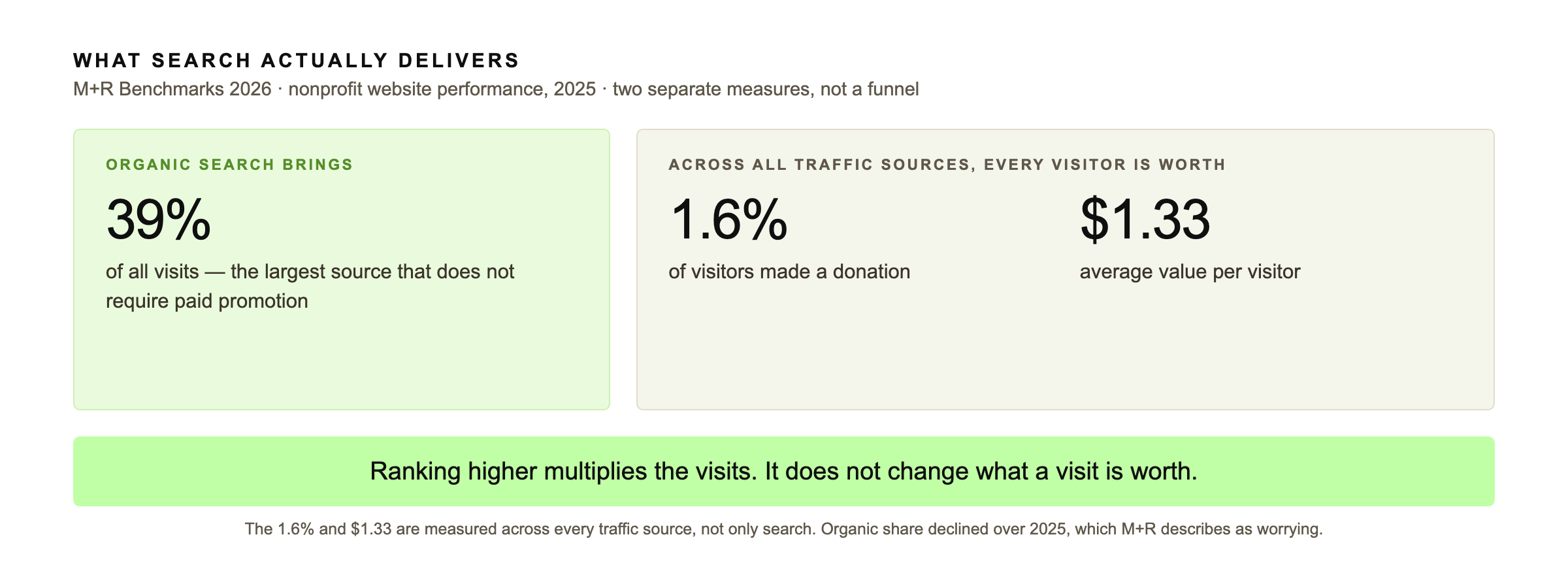
- Organic search still brought 39% of all nonprofit website visits in 2025, according to the M+R Benchmarks 2026 study — though that share declined over the year.
- Google’s own documentation says most sites already pass the technical requirements without doing anything, which is most of what generic SEO checklists sell you.
- The gap is after arrival. Mobile is 52% of visits but only 28% of donation revenue, and the average mobile gift is $88 against $168 on desktop.
- Across all traffic, 1.6% of visitors donate and each visitor is worth $1.33. Ranking higher multiplies that number; it does not change it.
- Search rewards pages that answer what someone typed, which usually means the ones describing what you do for people rather than the ones asking for money. No published benchmark measures this by page type, so treat it as reasoning rather than data.
Nonprofit SEO usually enters the conversation the same way. Somebody on your board read an article, and now there is a line item. Someone quotes a number for an audit. A consultant sends a spreadsheet with two hundred rows in it, most of them red. And underneath all of it is a quiet worry that your organization is invisible in a way everyone else has already solved.
It is worth saying plainly that the worry is out of proportion to the problem. Search is not a mystery your organization failed to learn, and it is already working: two in every five visits to nonprofit websites last year came from someone typing something into a search engine.
The harder question is what happens next. Half of those arrivals come on a mobile device, and mobile produces a little over a quarter of the donation revenue. That gap is where the money goes missing, and no amount of ranking closes it.
How low the technical bar actually is
Most of what gets sold as nonprofit SEO is a checklist of technical items. Read five nonprofit SEO guides and you get the same list: optimize for mobile, improve page speed, write meta descriptions, research keywords, claim your Google Business Profile. It is not wrong. It is just general web advice with the word nonprofit added, and it aims at a bar that is lower than the industry lets on.
Google is unusually direct about that bar in Search Essentials, its own documentation. The sentence is worth quoting whole: “There are actually very few technical things you need to do to a web page; most sites pass the technical requirements without even realizing it.”
The same page is equally blunt about what compliance buys you: meeting the requirements and best practices does not mean Google will crawl, index, or serve your content. There is no checklist that ends in a ranking. Think of wiring a building to code. Passing inspection is necessary, and it is not what makes anyone want to sit in the room.
Search still brings four visitors in ten
The sector reference for this is the M+R Benchmarks 2026 website performance data, covering 2025. Organic search accounted for 39% of all visits to nonprofit websites. Roughly two in every five arrivals came from someone typing something into a search engine and clicking through.
That share declined over the course of the year, and M+R does not soften it — they call any decline in organic traffic worrying, precisely because it is large and does not depend on paid promotion. AI summaries and social feeds are changing how people reach websites at all.
Still, two in five is not a channel to write off because a benchmark dipped. It is a large share of the people arriving at your site without you paying for them, which is exactly why the next number matters more than your ranking does. It is also why what happens after the first gift tends to move more money than what happens before the first click.
The nonprofit SEO gap nobody optimizes for
Now the part of nonprofit SEO that reframes the whole exercise. More than half of nonprofit website traffic arrives on a mobile device — phones and tablets counted together in M+R’s data. Much less of the money does.
Mobile
52%
of all visits
28%
of donation revenue
Average gift $88
Desktop
48%
of all visits
72%
of donation revenue
Average gift $168
A mobile visitor gives about half what a desktop visitor gives, and gives less often. M+R publish both halves of that: mobile is 52% of traffic but only 43% of donation transactions, and among people who reached a donation page, 11% of desktop users completed a gift against 8% on mobile. One caveat worth stating plainly — that device split is measured across all traffic rather than by source, so it is not specifically a statement about your search visitors. Search is 39% of the whole.
It is tempting to read that as a design failure and go rebuild the donation form. Sometimes that is right. More often it is context rather than layout. A search on a phone happens in a waiting room, on a bus, halfway through something else. Taking a call in a noisy room is not a worse conversation because the phone is worse; it is worse because of everything happening around it.
Which means the useful goal for mobile is often not the gift at all. It is capturing the person so the gift can happen later, on a screen and in a moment where a larger number feels reasonable. An email signup that works on a phone is worth more than a donation form that technically functions on one. That is the handoff we wrote about in nonprofit email marketing.
Which pages actually earn search traffic
Most organizations put their nonprofit SEO effort into the pages they care about most: the homepage, the about page, the donate page. Search rarely rewards those, because almost nobody types them.
No benchmark we could find measures organic traffic by page type, so what follows is reasoning rather than data. People search for problems and for places. Someone needs the thing you do, or needs to know whether you serve their area, or is checking whether you are a real organization before they give — which is as much a question of nonprofit branding as of search. The pages that answer those questions are your program pages, your eligibility and location details, and anything that documents your work concretely.
This has an awkward implication worth naming. A good share of the people search brings you are looking for help, not looking to give. That is not a wasted visit. It is your mission arriving through the front door, and it is also how an organization becomes locally known well enough that the giving follows.
A short list that fits a small team
Nonprofit SEO work is worth sequencing, because each item changes whether the next is worth doing. If your team is small, do the first two and stop for this quarter — a short list you finish beats an audit you file.
First
Give every real page a page of its own
One program per URL, with a plain title naming what it is and who it serves. A single page listing eight programs cannot rank for any of them.
Then
Say where you work, in words
Counties, neighborhoods, the towns you actually serve, written on the page rather than implied by a map embed. Claim your Google Business Profile while you are at it.
After that
Fix the mobile handoff before the mobile form
On a phone, make it easy to save you for later: a working email signup, a tappable phone number, a page that does not demand a pinch to read.
Last
Publish something on a schedule
Dated, specific, about work you actually did. This is slow and it compounds, which is the opposite of how it is usually sold.
What search cannot do for you
Search finds people who are already looking. It cannot create demand for a cause nobody is searching for, and it will not move quickly — anything that does move quickly in search is usually paid. If you need visibility on a deadline, that is what Google Ad Grants is for, and it has its own rules to keep.
There is a shop on every main street with an excellent window display and a door that sticks. Search is the window. It is genuinely worth having, and it has never once fixed a door.
If this is on your list
Most of the two hundred red rows will not change anything.
Two in five of your visitors already come from search. The work worth doing is making that arrival lead somewhere, which is a smaller and more specific job than nonprofit SEO is usually sold as. We are a nonprofit growth partner and this is the layer we work on. See how we work, or look at what support costs.
Frequently asked questions
Does SEO actually work for nonprofits?
Search brought 39% of all nonprofit website visits in 2025, so the channel plainly works. What it delivers is arrivals, not gifts. Across all traffic sources 1.6% of visitors donated, and averaged over every visitor, donors and non-donors alike, a visit was worth 1.33 dollars. More traffic multiplies whatever your site already converts rather than improving it.
How long does nonprofit SEO take to work?
Longer than anyone selling it will say, and it compounds rather than switching on. Google states that meeting its requirements and best practices does not mean it will crawl, index or serve a page at all. If you need visibility by a specific date, paid search is the honest answer.
Should we pay for an SEO audit?
Usually not as a first step. Google states in its own documentation that there are very few technical things a page needs, and that most sites pass those requirements without realizing it, so a long technical report often lists items that change nothing. Spend the money on program pages and on what happens after someone arrives.
Why does our mobile traffic not convert?
It is normal, not a fault. Mobile made up 52% of visits but 28% of donation revenue, and the average mobile gift was 88 dollars against 168 on desktop. Phone visits happen in the middle of something else. Aim mobile at capture, such as an email signup that is genuinely easy to complete, and let the larger gift happen later.
Which pages should a nonprofit optimize first?
Program and service pages, plus anything stating where you work. This is reasoning rather than a measured benchmark: people search for problems and places, not for organizations they have never heard of. Give each program its own page with a plain title, name the areas you serve in words, and expect a good share of that traffic to be people seeking help rather than people ready to give.
Figures are from the M+R Benchmarks 2026 study, covering 2025 activity, and from Google Search Essentials, and were current when this article was published. connectNPO does not provide legal, tax, accounting, or Form 990 advice.