Hollin House Museum & GardenA sample house-museum website. The organization is invented.
An 1884 river merchant's house and walled garden in the Hudson Valley: five staff, about fifty docents, 24,000 visitors a year, a budget of about $850,000. The most finished of the fifteen, on purpose: a museum is judged on care, so the site is set like a catalogue, and the visit information comes before anything else.
- KindHouse museum and garden, open by season
- BudgetAbout $850,000; revenue $880,000 in 2025
- Staff5, and about 50 docents
- Pages6; seasons, closures, prices, exhibitions, events and objects staff-editable
- Look"The catalogue": the premium sample. A serif set with care, tabular figures, hairlines, plates with captions
- Real?No. Every object, person, number and document is invented and labelled; no maker is named; no person is pictured
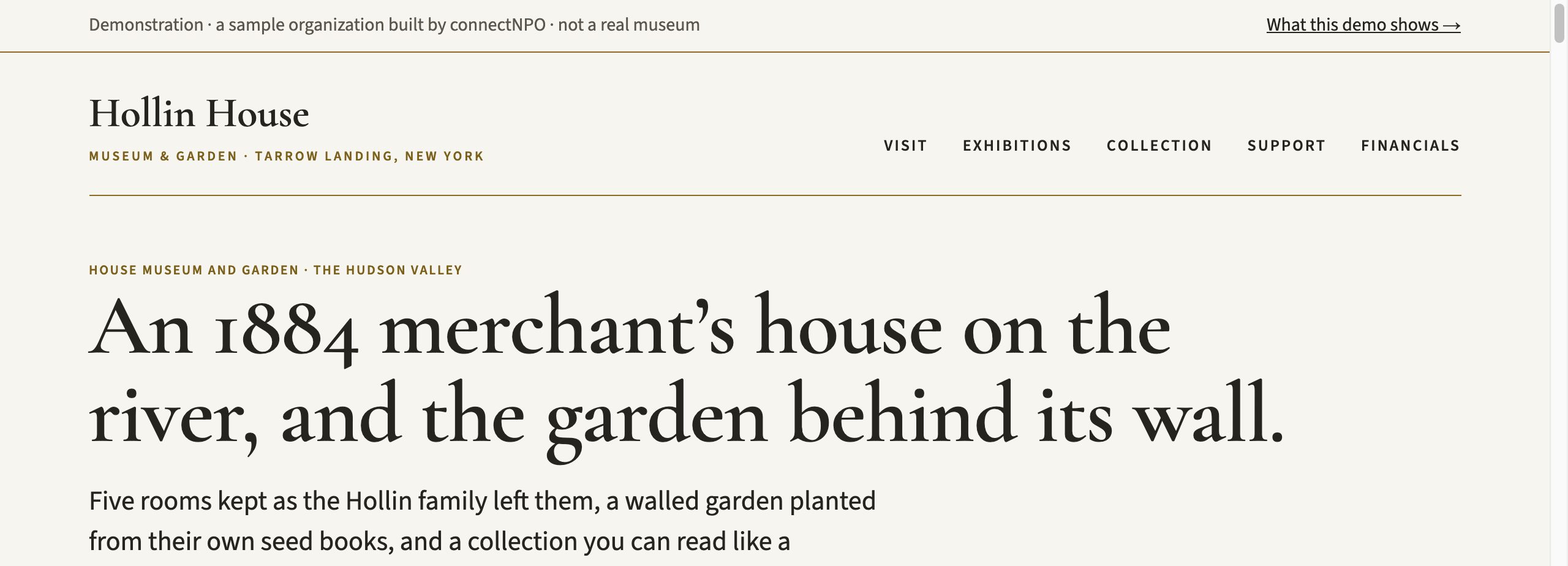
One name, one look, one voice.
Every sample has its own brand, set once and used the same way on every page, from the home page to the financials. It is the same work we do for your organization.
- A name and a wordmark, set in one display type
- Four or five colours, each with one job
- One type for reading, chosen for the people the site serves
- One line that says what the organization does, used in search, listings and the share preview
An 1884 merchant’s house and walled garden on the Hudson.
Six things to press, in order.
Each one is a working feature, and each one is an example of what we build. Nothing you do on the site is recorded.
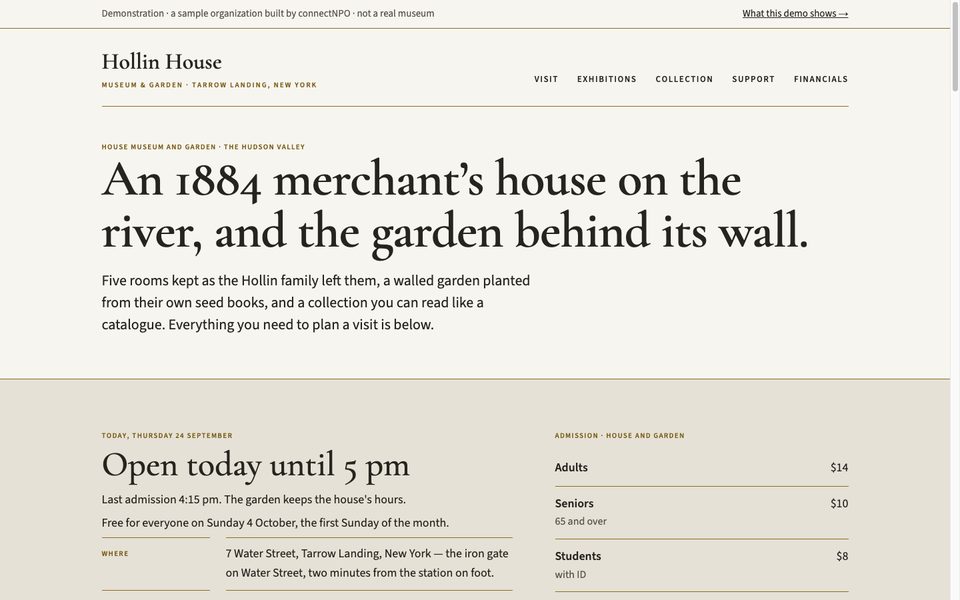
Plan your visit, computed
"Open today until 5 pm, last admission 4:15", "Closed today, next open Wednesday 10 am" or "Closed for the season": worked out from the seasons sheet, the closures and the clock. The first Sunday of the month says it is free.
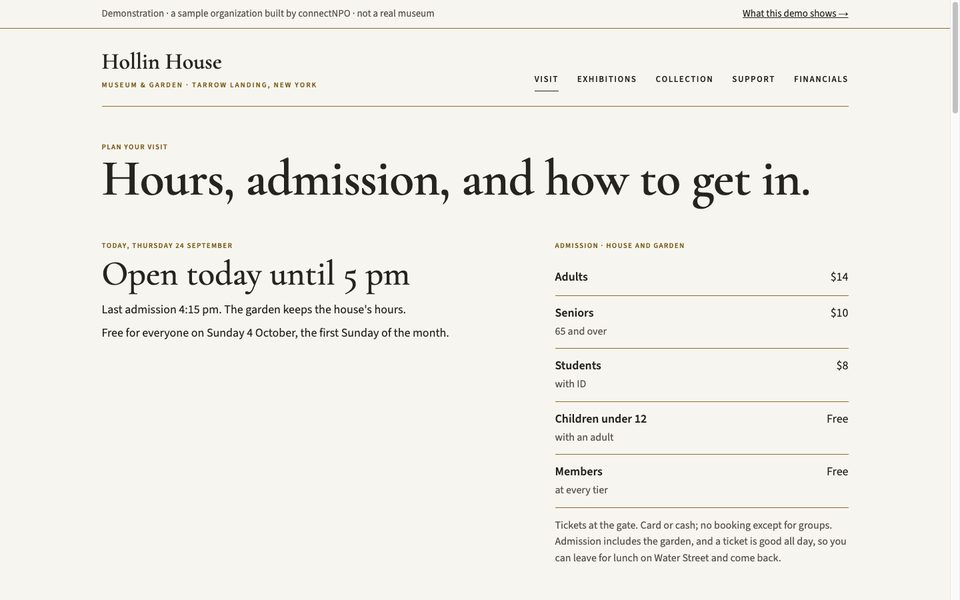
Hours and admission as tables set with care
Hours by season, closures that list themselves, admission with right-aligned prices and tabular figures, accessibility stated plainly. A group-visit request in demo mode checks the date against the same calendar.
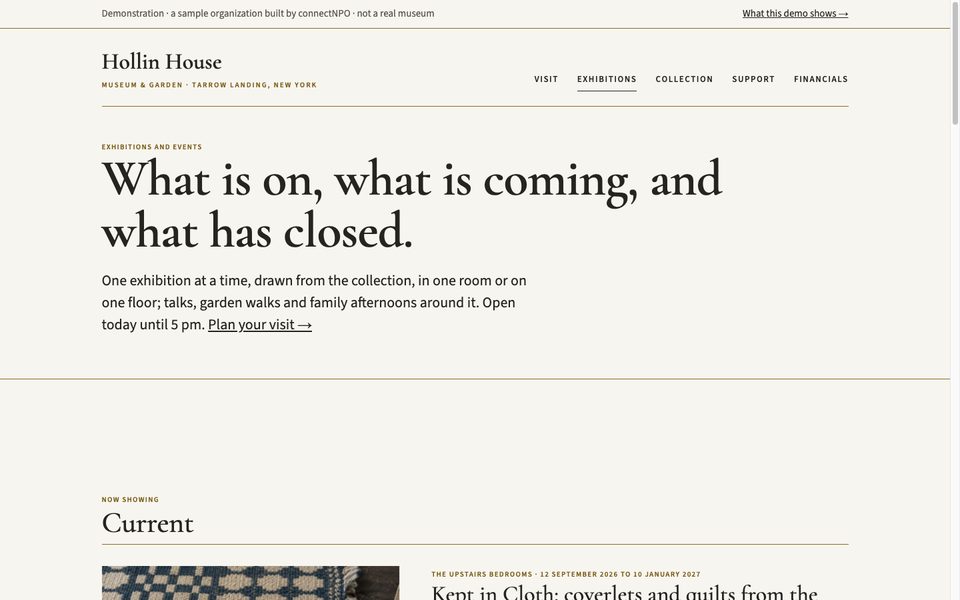
Exhibitions that move by themselves
Each exhibition has dates and moves between current, upcoming and past on its own. Talks, walks and family afternoons carry places and a filled count; a past event leaves by itself. Exhibition and event data go out for search engines.
The collection as plates
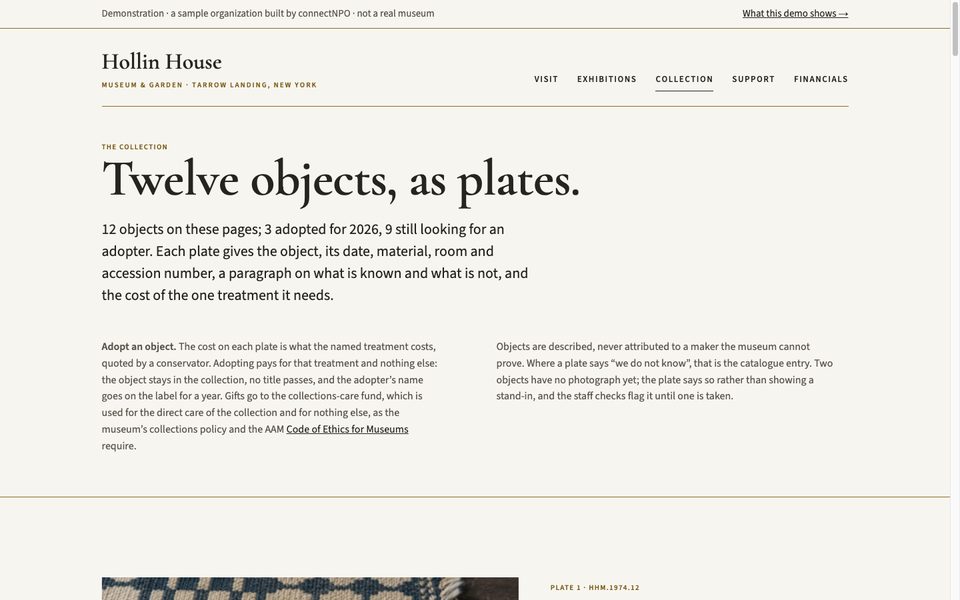
Twelve highlighted objects, each a figure with a caption and a definition list: object, date, material, room, accession number. Adopt an object names the treatment, its cost and what it pays for; an adopted one says so and stops asking. Two plates have no photograph yet, and say so.
Membership as a real comparison table
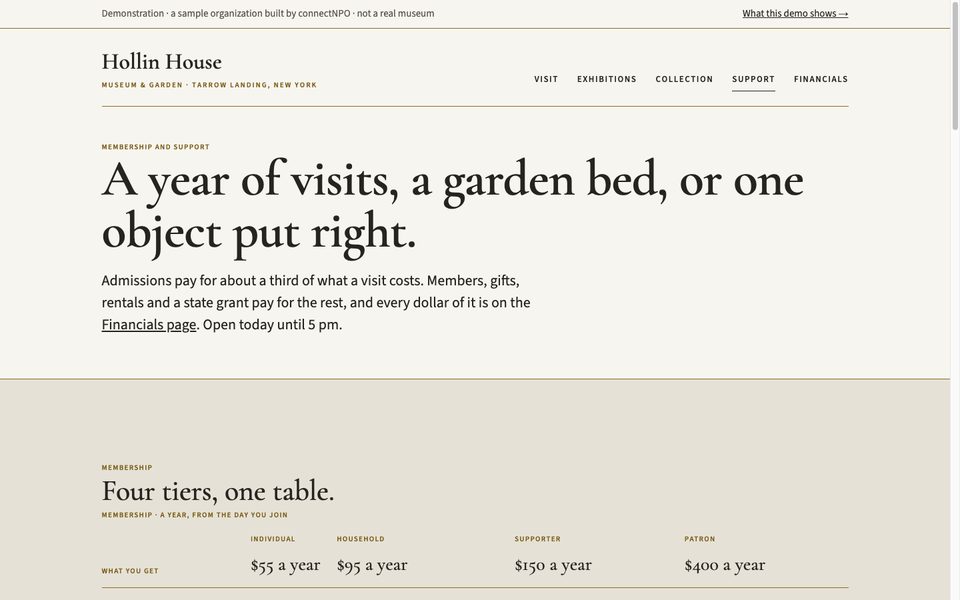
One row per benefit, one column per tier, built from each tier's own list of benefits, so a new benefit is one line on a staff sheet. 1,180 member households, with how they are counted.
What a visit costs, what a ticket brings in
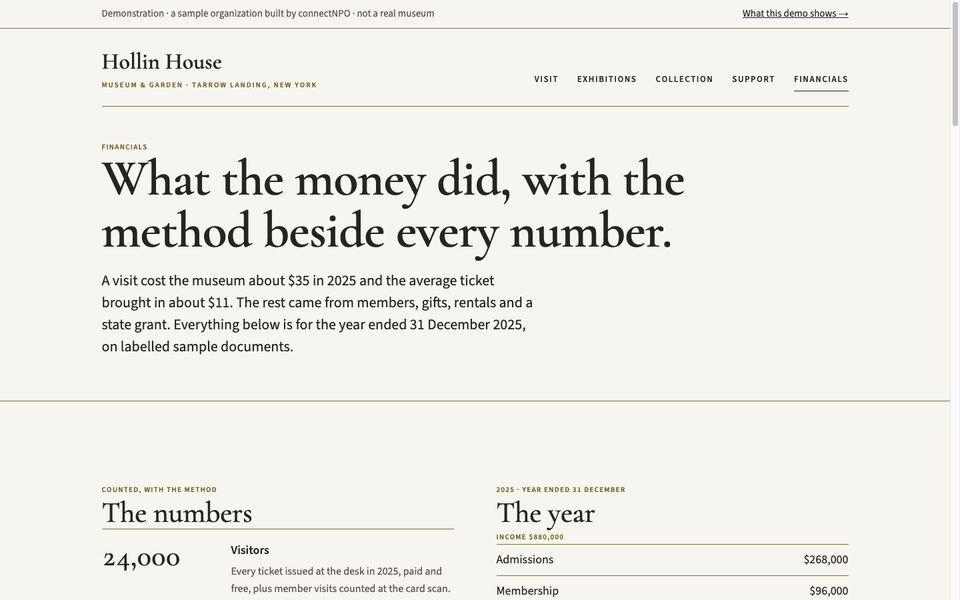
About $35 a visit and about $11 a ticket, both on the page with their method. The state arts grant in one paragraph, the year adding up, three 990s and the review as labelled samples.
Sign in. No password. Nothing you change is saved.
The button below signs you in to the real staff area as sample staff. You see what the organization's staff would see: one menu, a tile per tool, and the checks.
- 01Tiles for Seasons, Closures, Admission, Exhibitions, Events, Collection highlights, Membership tiers, Garden notes, Numbers, Financial documents, Year-end
- 02Checks: no season covering today, a season ending with none to follow, an exhibition closing within 14 days with nothing upcoming, an event full, an object with no photograph, a garden note older than 40 days
- 03The garden note is dated and the home page shows the date, so a stale one is visible to everyone
- 04Press Update on anything and the screen says "Nothing was saved"
A house and a garden, in a minute.
A sample of the one-minute videos in the plan: the rooms, the visitors, and what a visit costs against a ticket, told from the museum’s own numbers.
- 1You send the photos and clips you already have, and a line or two on what the video is for: year-end giving, volunteers, an event, the story in your 990.
- 2We write a one-minute script from what is on your site and in your filing, and send it for your yes.
- 3We make it within one week of getting your material: about a minute, wide and vertical, captions burnt in, and a text version for your site.
Up to five a year are in the plan, at no extra charge. The first five nonprofits can have one free: see the offer →
Sample video. Hollin House is invented, so it has no footage of its own: the clips are free stock (Pexels), and the narration is a synthetic voice. For a real organization connectNPO uses only the photos and clips its staff send.
Read the script instead (about one minute)
A river town in the Hudson Valley, early in the morning.
This is Hollin House Museum and Garden, a river merchant's house, built in 1884.
Five rooms kept as the family left them. A walled garden, planted from their own seed books. And about 4,180 objects in the collection.
In 2025 the house was open 218 days. 24,000 visitors, about one in six on a free first Sunday. 61 school visits, and 6,400 hours from the docents.
Fourteen objects were conserved, paid from the collections-care fund, and from nothing else.
The museum spent $851,000. Fifty-two cents of every dollar went to the staff and the docents, twenty-two cents to the house and the garden.
A visit cost the museum about $35. The average ticket brought in about $11, because children, members and first Sundays are free.
$880,000 came in: admissions, members, gifts, rentals, the shop, and a state arts grant.
Every filing, every number, and how it was counted, is on the site. Visit, become a member, or adopt an object.
Sample video · Hollin House Museum & Garden is invented and every figure is a sample. Clips are free stock (Pexels). The narration is a synthetic voice and the music is AI-generated. Made by connectNPO.
What this sample shows that we build.
Plan your visit, computed
Seasons and closures; the first Sunday says so.
Tables set with care
Hours, admission, tiers: tabular figures, hairlines.
Exhibitions and events by date
Current, upcoming, past; places that vanish.
The collection as plates
Twelve objects; adopt one for a stated cost.
Group-visit request
Checked against the calendar; demo mode.
Museum data with hours
Opening hours from the seasons; exhibition and event data.
Cost per visit, with its method
The year adds up; three 990s, the review, the letter.
Staff preview
A public button into the real staff area, read-only.
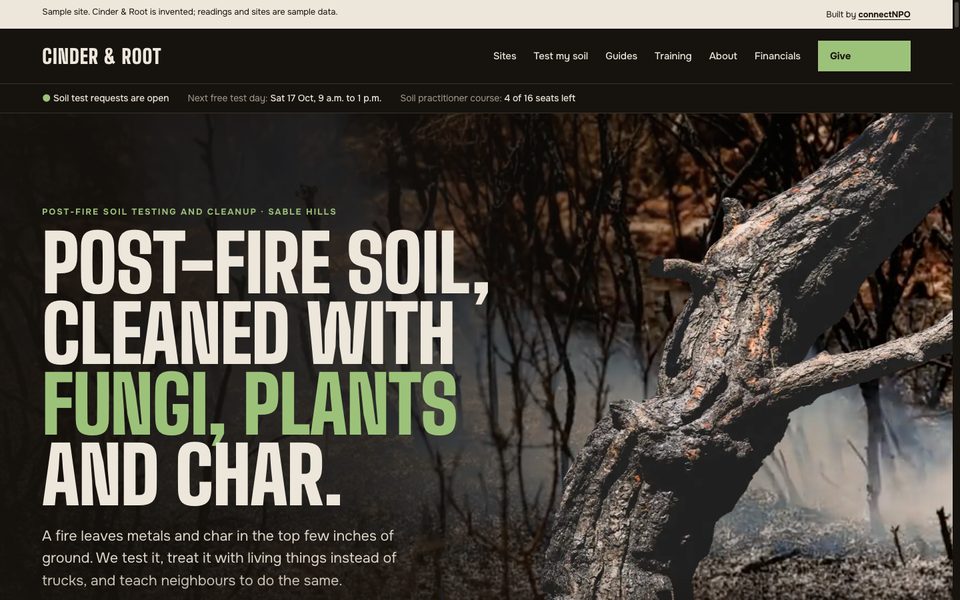
Cinder & Root
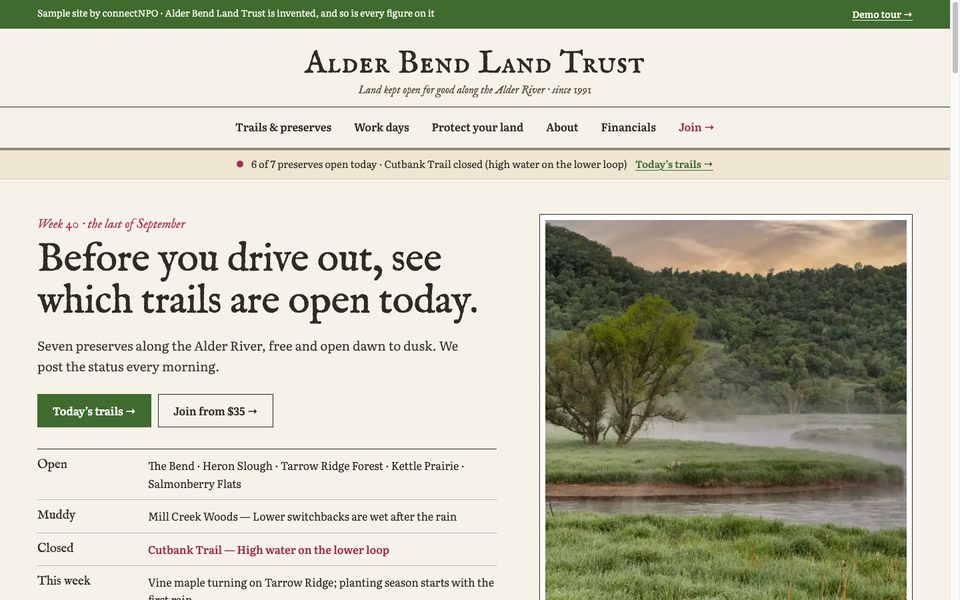
Alder Bend Land Trust
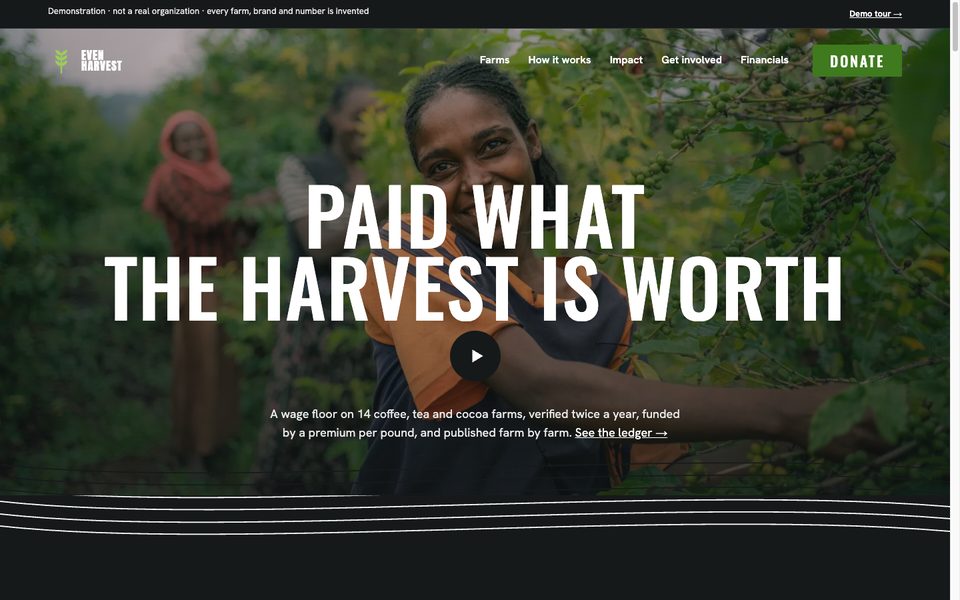
Even Harvest
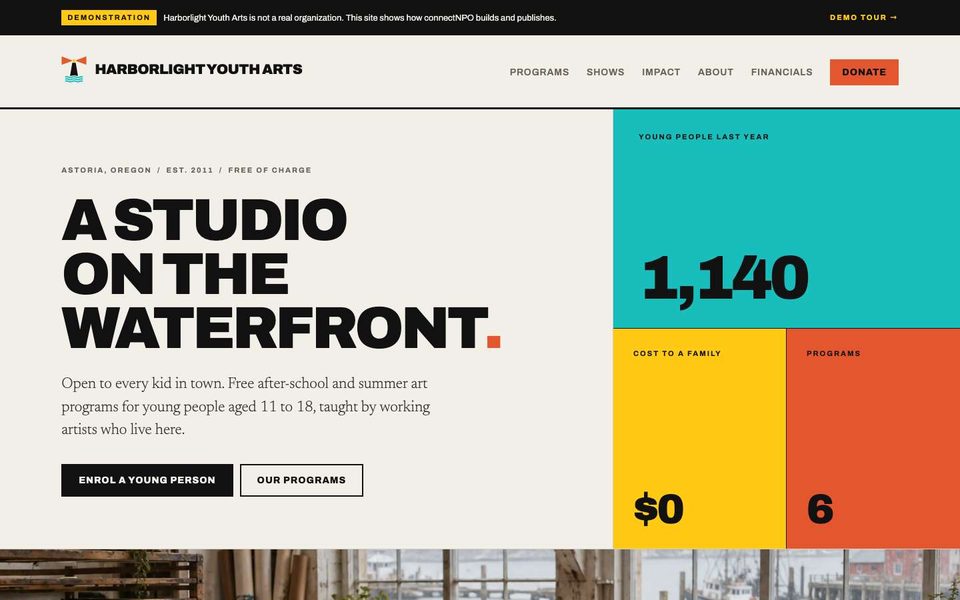
Harborlight Youth Arts
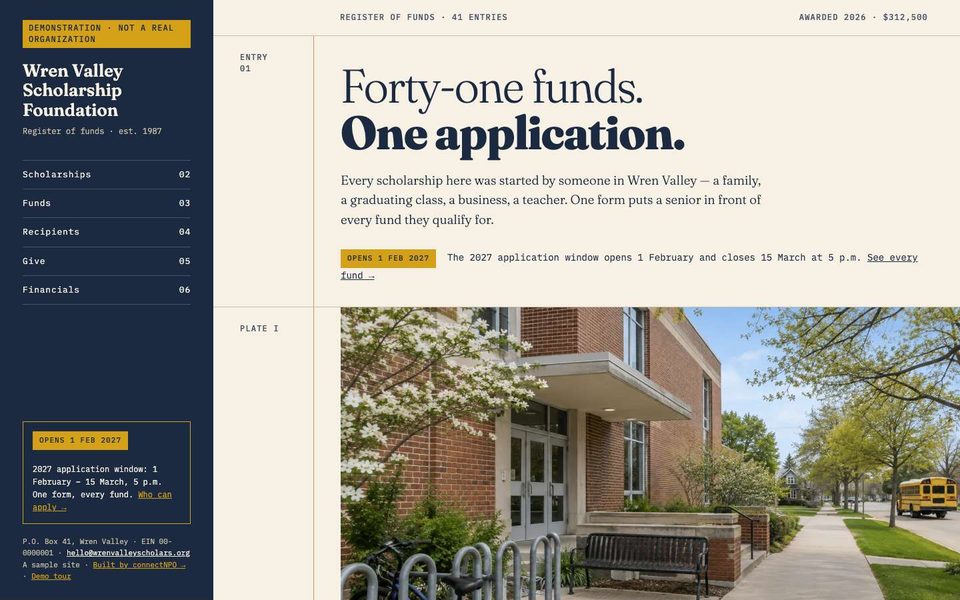
Wren Valley Scholarship Foundation
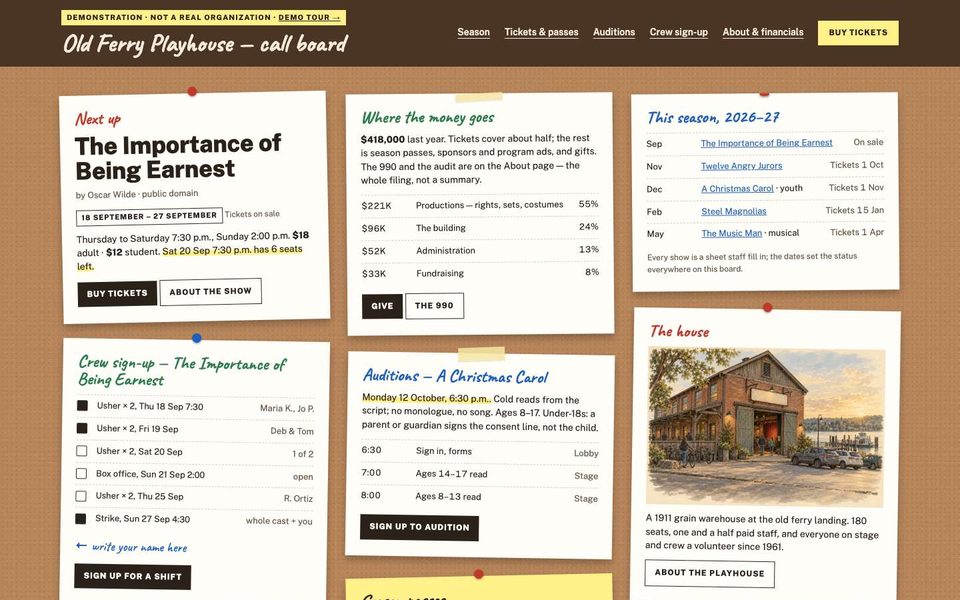
Old Ferry Playhouse
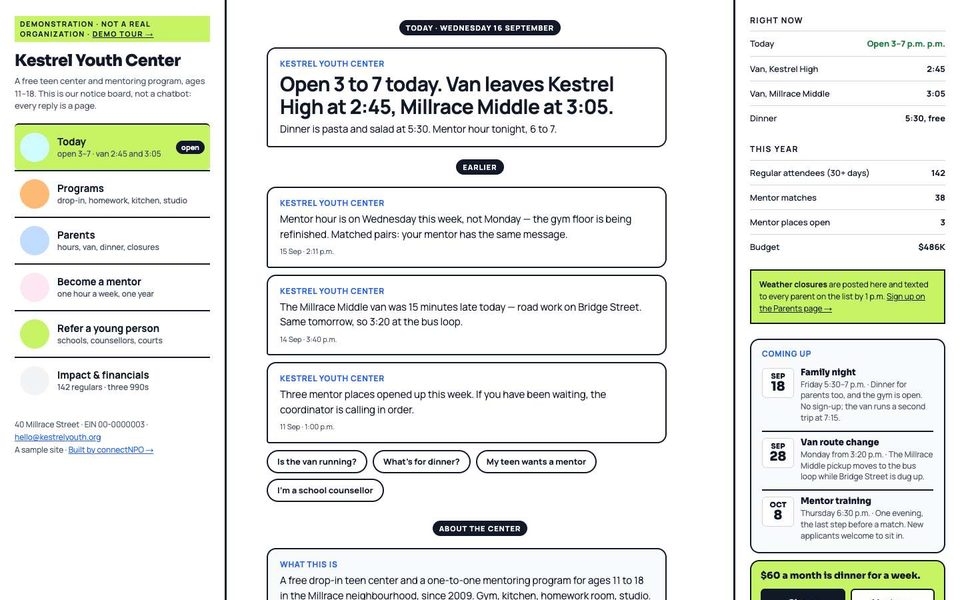
Kestrel Youth Center
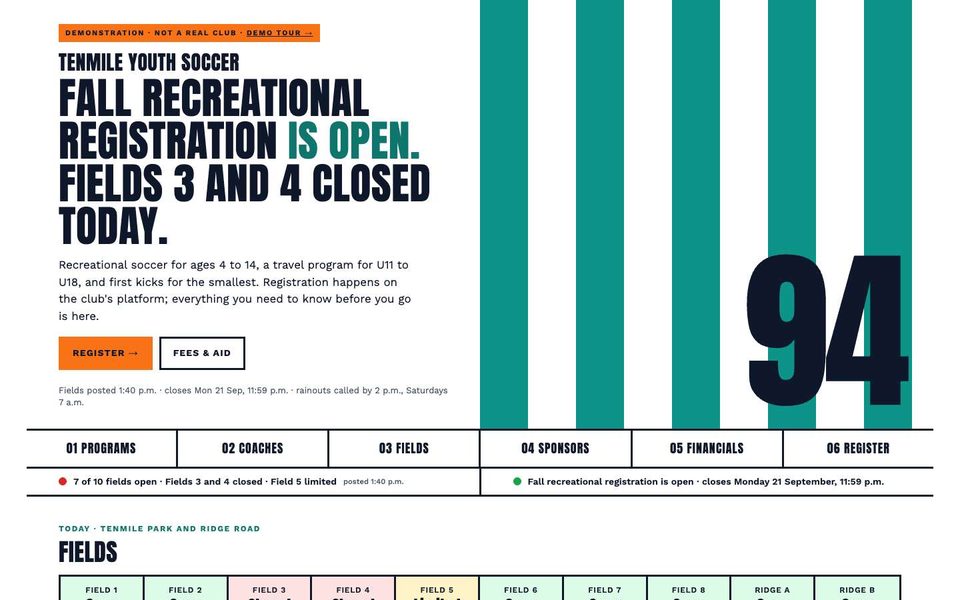
Tenmile Youth Soccer Club
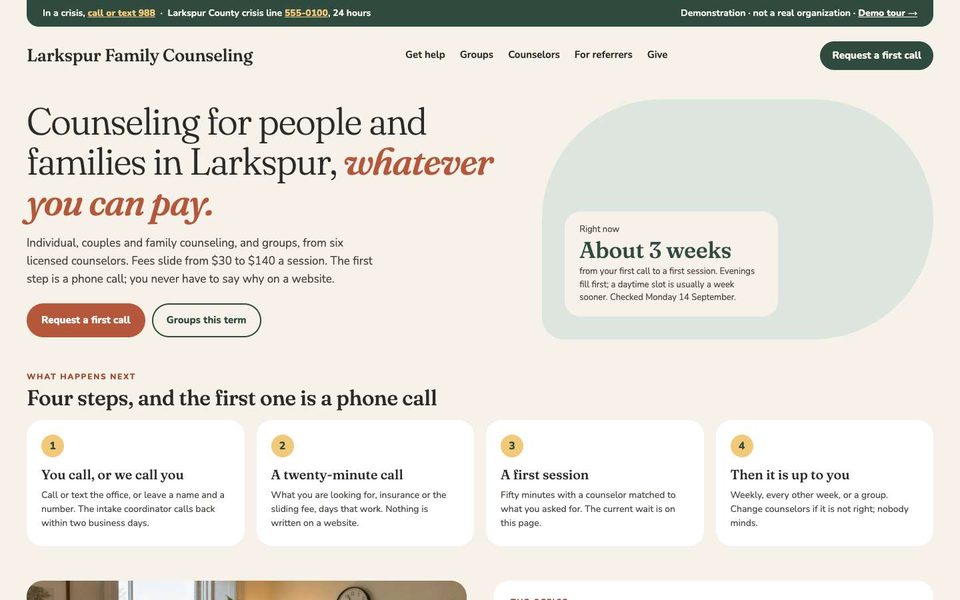
Larkspur Family Counseling
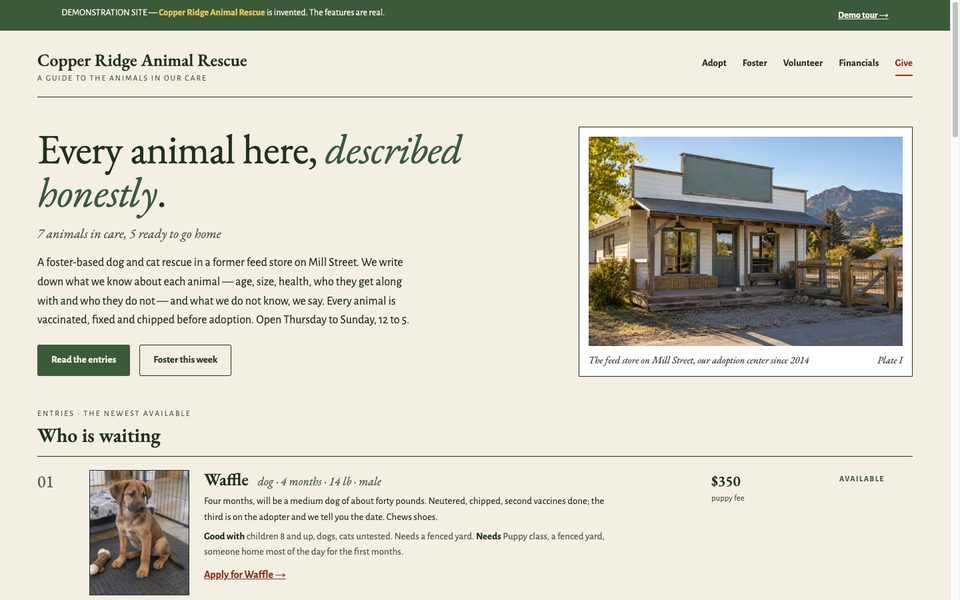
Copper Ridge Animal Rescue
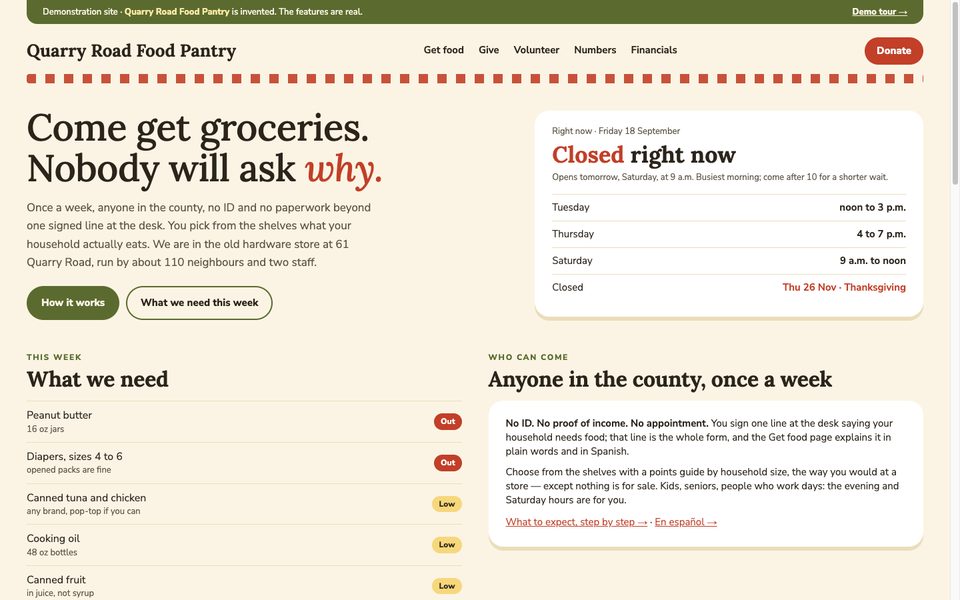
Quarry Road Food Pantry
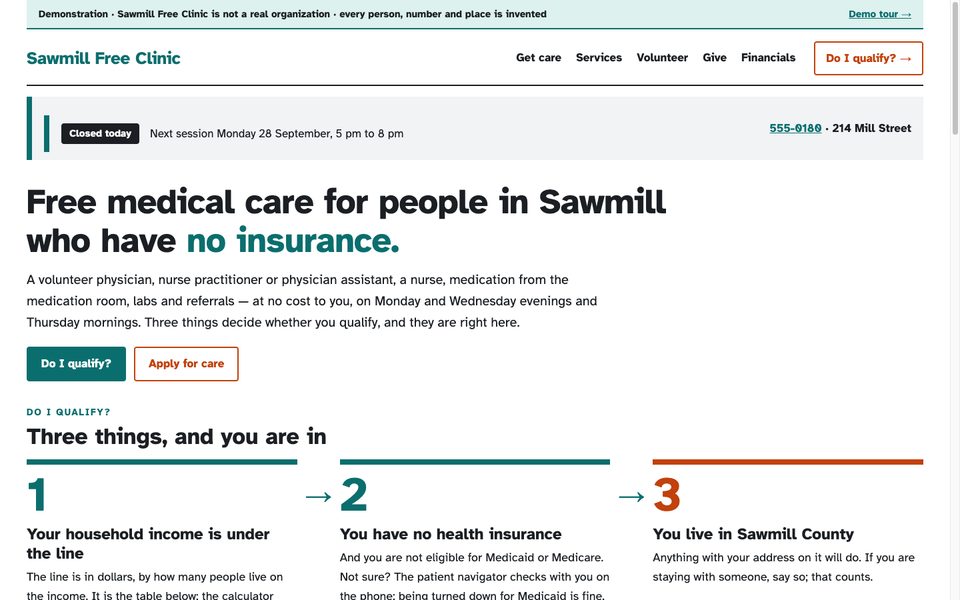
Sawmill Free Clinic
Aging Well Navigator
Ashgrove Haven
Close to your nonprofit?
Tell us what yours needs that Hollin House does not show. In writing, in your own time; we reply within one business day.
What you have, what is missing, which sample is closest. No account, no call to book.
Tell us what you need →